

Introducing a New Folk Horror Fiction Anthology
by Hollie Starling
This was pitched as a promotional piece for my new book, but I’ve already hit a snag. The book in question is a collection of short fiction that in different ways draws on working-class themes and experience, all ten contributions by working-class writers. The genre is horror. The problem: how do I describe the class-consciousness I developed growing up in a once industrious town in north Lincolnshire without the sour note of mentioning the county’s most famous daughter? To dangle the promise of myth and terror, yet side-step her climbing out the fissure that connects hell to Grantham to stalk the land in search of milk to snatch and the dignity of the working poor to grind into dust?
But I must resist, because Lincolnshire is an ancient and richly-storied land, the cradle of scores of vital, ordinary people who lived full lives and died without note, too various to be reduced to one schlocky point of reference, however long her shadow. “Those who tell the stories rule society”: a quote attributed to Plato, but I suppose even the greatest minds are wrong from time to time. It is not who tells the stories but who writes them down. A distinction that until quite recently separated the literate elite from the so-called ‘masses’. Greengrocers’ daughters who go on to become Prime Ministers may, through dutiful chroniclers, have their names ring through the ages. But oral transmission, the telling and retelling of stories and of the folklore those stories become, offers a glimpse at an alternative national history.
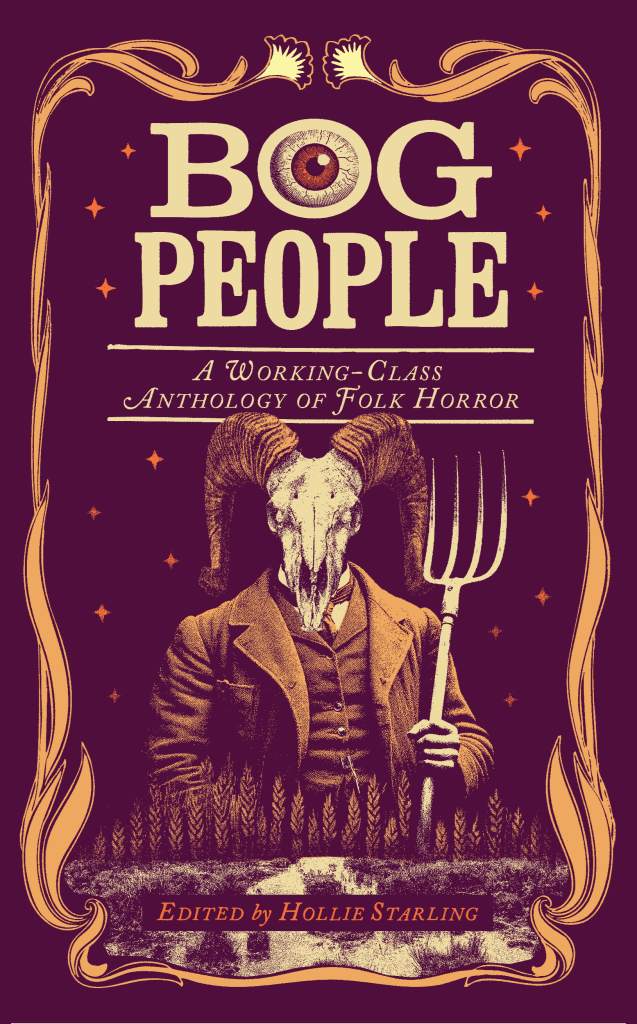
This is the cause behind Bog People : A Working-Class Anthology of Folk Horror, which is available now for pre-order. The labouring classes comprise the innumerable majority of Britons that have ever lived, yet their names and lives have been struck from the record. Though they remain nameless, we hear the echoes of their voices in our folk heritage. In the stories, traditions, customs and songs that by word-of-mouth persist and endure through generations. They are at once communal and intimate, dynamic and adaptable, and, in their resistance to erasure, revolutionary.
Despite its status as England’s second biggest county, Lincolnshire seldom finds representation in popular culture. So it was important to stage my own story in the land of the ‘yellowbelly.’ This is a term whose origins are disputed. Calling someone a yellowbelly may have been a nod to the yellow waistcoats of the Lincolnshire Regiment, or the stained undersides of sheep grazing in the mustard fields of Lincolnshire’s famously fertile soil. Another theory is a hangover from the time of the Saxon wapentakes, when an area of the fens was known as Elloe Bellie, meaning ‘out of the boggy hole.’
This bogland genesis is my favourite, as I wanted my own addition to the yellowbelly origin myth to speak of things submerged. My story follows an academic of Lincolnshire folktales as he gives into his worst impulses, a cataloguer driven first by a scholarly appetite and then by the deviant. (NB. it was entirely conceived and written before I was in touch with the Lincolnshire Folk Tales Project.) ‘Yellowbelly’ is a nasty little tale that is mindful of the legion of working-class women who, minus official record, nevertheless refuse to lie dormant. I was interested in the conditions under which a woman’s body, ancient and modern, becomes a prism for isolation and punishment, fetishism and control. This yellowbelly is that other meaning of yellow; a coward.
It was only after I had written it that I learnt of Amcotts Moor Woman. One of the UK’s few female bog bodies, she was disturbed from her north Lincolnshire resting place by peat-diggers in 1747. Amcotts Moor Woman is an enigma; all that remains of her is a hand, a leg bone and a shoe. But her deliberate placement in the bog suggests that hers was a ritual death. Today, she continues to be confined, away from view, as a guest of the Spalding Gentlemen’s Society. Like the woman in my story, I saw her captivity and invisibility as an intolerable cruelty and an ending that needed to be rewritten.
Folk horror is a brilliant genre for exploring what lies beneath; topographically as well as psychologically. In Bog People Jenn Ashworth explores how the past can terrorise the present, in a horrifying family psychodrama in which the skin of alcoholics recalls that of bodies found in the peat bogs of the North West. A.K. Blakemore takes us to a palace of bones for a portrait of insularity and intolerance, exposing how easily such a psyche can slip into depravity. Daniel Draper, winner of the Bog People x Chatto & Windus competition for unpublished working-class writers, serves up a dish whose unusual flavour nevertheless tastes strangely of home. Of course, the title is a barbed allusion to the ‘great unwashed,’ but Bog People is not just a polemic against the inequality in our system of rule. Simply, it is a feverishly entertaining collection of chilling tales by some of the most talented writers of contemporary horror. Pre-orders will arrive for Halloween. Dark nights are made for engrossing books; the lady might not be for turning, but these pages are.
Bog People : A Working-Class Anthology of Folk Horror will be published in hardback and eBook by Chatto & Windus on 16th October and is available to pre-order now. For updates visit holliestarling.com and follow Folk Horror Magpie on X and Instagram.
The project is grateful to Hollie Starling for sharing information about her book. You can also read Hollie’s reflection on the personal significance of Lincolnshire folklore, ‘Breathing Life into Lost Tings’ here: https://lincolnshirefolktalesproject.com/2024/10/14/breathing-life-into-lost-things/


Leave a Reply