


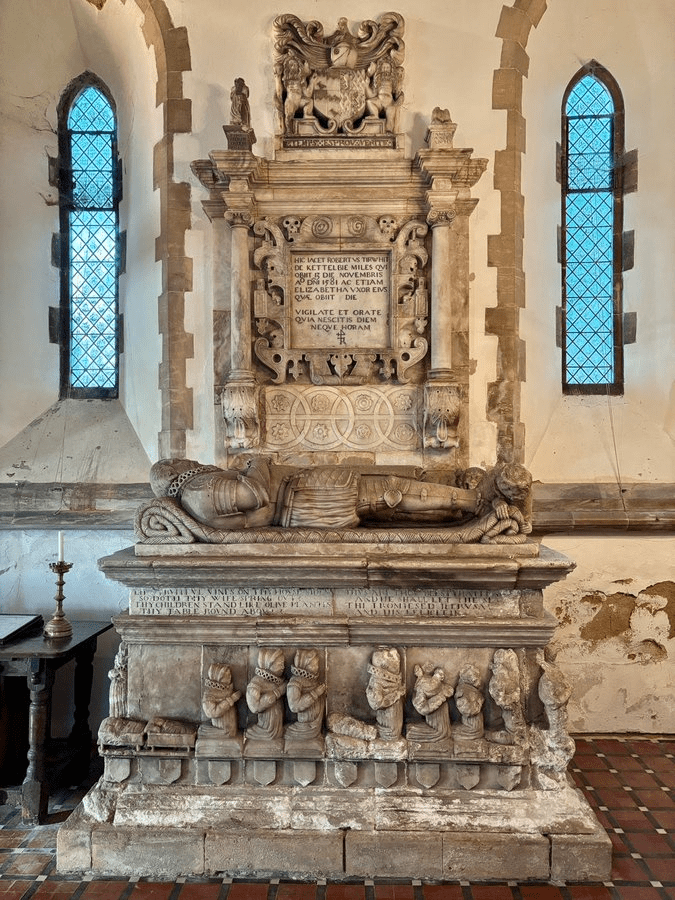
In All Saints’ Church, Bigby, you can see a sixteenth-century alabaster Twywhitt family tomb, depicting a supplicant wild man of the woods, or wodewose. He is attached to a Tyrwhitt family legend, and is almost certainly an inspiration for the legend of the Wild Man of Stainfield, many miles to the south, which is possibly the best known wild man legend in the East Midlands.
He has suffered some damage to the head and neck, but is finely carved and has an expressive face and simian fingers. The family crest at the top of the tomb has two wild man supporters, each casually holding a big club. Such a retinue was meant to signal the family’s strength, honour, and fertility.

Around the base of the tomb are depictions of the couple’s twenty-two children, arranged in order of birth. Seventeen are shown praying for their parents; the other five, who evidently died in infancy, are depicted as infants tucked into cribs.
The church is usually locked, but you can look it up online and should then be able to obtain the key from the church warden if you plan ahead.
Click here to read our entry about the Wild Man of Stainfield.
Words by RORY WATERMAN




Leave a Reply