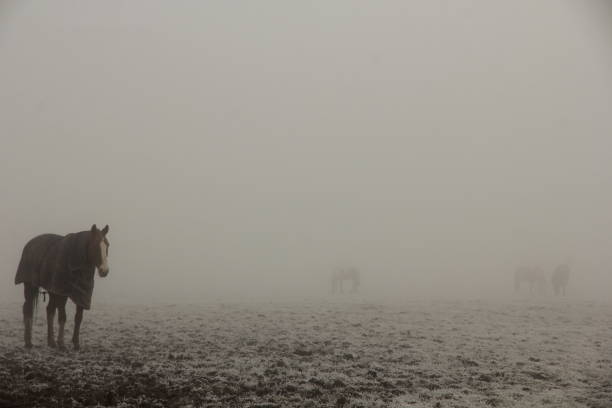
Gibraltar Point Fog Horse

Image by Barry Eastwood, Group of horses standing in field on frosty and foggy day with grey sky.

Legend has it that a farmer on his way to Skegness Market tried to take his horse on a shortcut along the beach at Gibraltar Point. The day was foggy, and the farmer lost his way in the mist and drowned in the rising tide. Since then, the frenzied sound of horse-hooves can supposedly be heard on that beach when the fog is thick.

The story is appended to a recollection of a supposed sighting of a ghostly horse (or rather, the sound of its hooves) by Sean McNeaney, author of the Lincolnshire Gothic blog. He writes that he found references to this tale, ‘dating from the 1700s’, in ‘a cutting from an unspecified publication’ he chanced upon at the Lincoln public library. The full story can be found here.

Have you heard this story told or know of any additional details? Please get in touch!

Words by ANNA MILON


In September 2024, working with the Lincolnshire Folk Tales Project and Adverse Camber Productions, Year 5 pupils at Skegness Junior Academy opted to work with this tale, to tell a wholly new story through performative storytelling. It was very exciting, and included two phone boxes, and two groups of friends meeting on the beach, where they encountered a foggy storm. Here are the pupils who made this original story, pictured with professional storyteller Pyn Stockman.
Gibraltar Point is a National Nature Reserve (NNR). Photograph taken September 2024.

Addition by RORY WATERMAN

One response to “Gibraltar Point Fog Horse”

Leave a comment

About the project

‘Lincolnshire Folk Tales: Origins, Legacies, Connections, Futures’ is a project funded by the Arts and Humanities Research Council (grant number AH/Y003225/1), and is led by Dr Rory Waterman and the Research Fellow Dr Anna Milon in the School of Arts and Humanities at Nottingham Trent University. The project explores the origins, legacies, intertextual and social connections and futures of Lincolnshire folk tales (LFTs), and is intended to facilitate wider engagement with this heritage from writers, the general public, and scholars.

Recent Articles