

Lincolnshire’s most famous example of a witch trial, and one of the most widely discussed and embellished in the early seventeenth century. The ‘witches’ were Joan Flower and her daughters, Margaret and Philippa, servants to the Earl and Countess of Rutland at Belvoir Castle near Grantham. They were accused of killing two young brothers, Henry and Francis Manners, who were heirs to Francis Manners, the Earl of Rutland. Joan apparently died in Ancaster, on route to trial in Lincoln, when she choked on a piece of bread: she allegedly requested it, saying that if she was guilty it would choke her, and this was taken as evidence, further incriminating the daughters, who confessed. Confessions in witch trials were normally encouraged by means of extreme torture, of course. These ‘witches’ were executed on 11 March 1618.
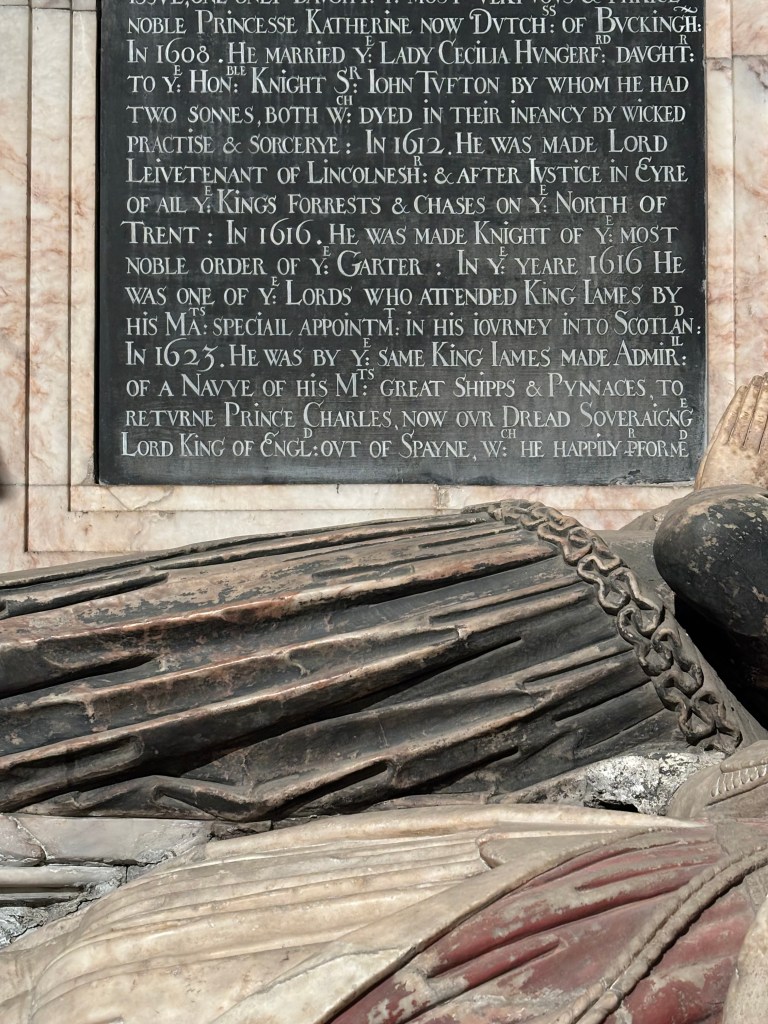
The commemorative monument to the Earl and Countess, in Bottesford church, Leicestershire, notes that they ‘had two sonnes, both wch dyed in their infancy by wicked practise & sorcerye’. In Witches: A Tale of Sorcery, Scandal and Seduction (Cape, 2013), the historian Tracy Borman makes the case that the women were likely framed in a murder plot by George Villiers, who had designs on inheriting the Rutland title, and who married the sole surviving heir in 1620. Many books on Lincolnshire outline the story, e.g. Lucy Wood, The Little Book of Lincolnshire (2016). Hilda Lewis’s historical novel The Witch and the Priest (1956) fictionalises the aftermath, and follows the experiences of an old priest who played a role in condemning the women to death.
The trial was recorded in an anonymous contemporary pamphlet, The Wonderful Discoverie of the Witchcrafts of Margaret and Phillip Flower, Daughters of Joan Flower neere Beuer castle (1619). In 1620, the first of many extant ballads recounting a version of events appeared: Damnable Practises of Three Lincolnshire Witches Joane Flower and Her Two Daughters. While both the pamphlet and the ballad state that Joan Flowers requested bread and butter as her last meal, some time before the eighteenth century her desire for food transmuted into a request for the eucharist, lending a more explicitly supernatural dimension to her demise. If bread blessed by a priest stuck in the woman’s throat, then surely her crime was an affront to God himself. Borman (2013) further elaborates that Joan’s request was an attempt to prove her innocence by an ‘ordeal […] practised for centuries’ in which a person’s ability to swallow blessed bread was used to judge their guilt of a crime. Marion Gibson, in Early Modern Witches (2000), provides an historical account of the trial. Watch a short description broadcast on BBC East Midlands Today in 2015 here.
Words by ANNA MILON & RORY WATERMAN

 Lincolnshire Folk Tales Project
Leave a reply to A Witch of Kirton in Lindsey – Lincolnshire Folk Tales Project Cancel reply