


This is a variant of the ‘phantom hitchhiker’ legend, common in twentieth-century and contemporary folklore concerning ghosts. The ghost of a young woman is said to flag down unsuspecting motorists at night, on a road adjacent to the former RAF Metheringham, saying her boyfriend has fallen off his motorbike. She then disappears, leaving behind the smells of rotting meat and, in some accounts, lavender. In some versions, or alleged sightings, she is wearing a green mac and a grey headscarf, and the last people see of her before she vanishes is her skull facing them from beneath her scarf.
Bruce Barrymore Halpenny, whose rendition of this story in his book Ghost Stations (1986) is the main source of the tale. He claims that a nineteen-year-old woman called Catherine Bystock was killed here in 1945, when her Flight Sergeant boyfriend, stationed at RAF Metheringham, lost control of his motorcycle. More on this can be found at Mysterious Britain. There is no evidence to support this sad backstory, though.
Daniel Codd discusses the stories associated with the Metheringham Lass in Haunted Lincolnshire (Tempus, 2006). In 2022, a group called Retford Ghost Hunters claimed to have taken a photograph of her, and this was picked up by national and international media. You can judge for yourself here. Rory Waterman includes a modernised adaptation of the story in Come Here to This Gate (Carcanet, 2024), in which the apparition is a young man’s delusion. In another poem, by Leanne Burnham-Richards and included in the anthology Not of This Wold (Pylon Phaser, 2025), the Metheringham Lass appears to save a woman from danger. This tale now has its own episode of the BBC’s ‘Secret Lincolnshire’ (2024), narrated by Rory. Listen here: https://www.bbc.co.uk/sounds/play/p0j564zh.
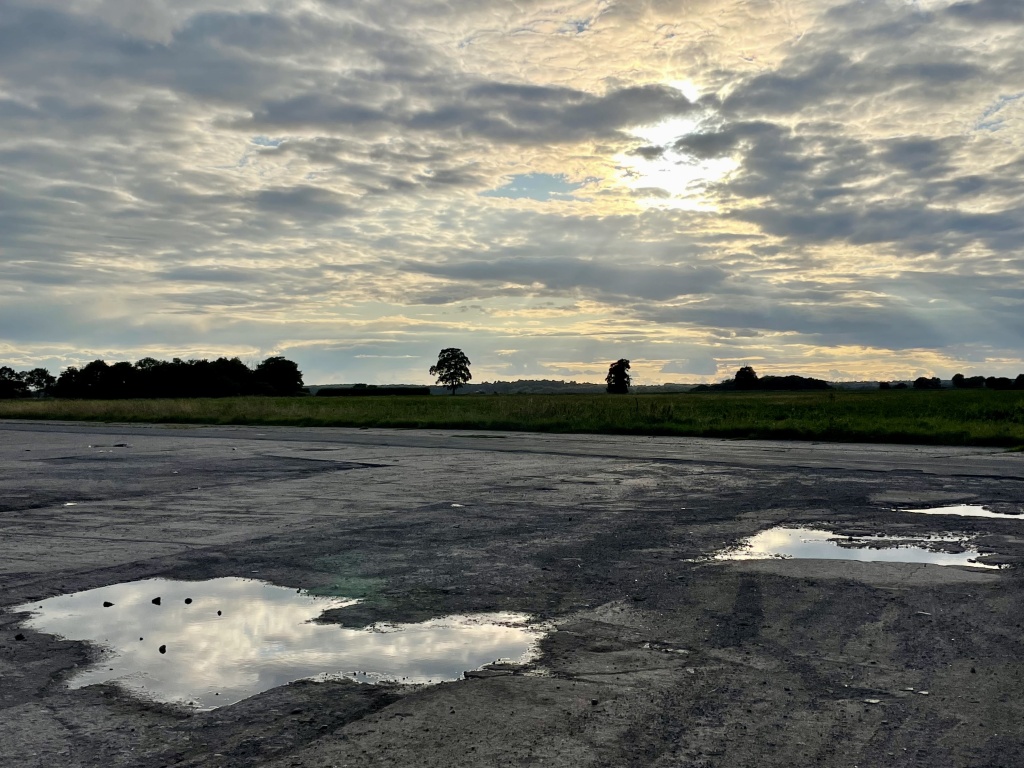
A lonely lane now crosses the site of the base (operational 1942-5), atop its only partly-remaining runway. There is a memorial to 106 Squadron on part of the old peri-track that is also now a country lane, and at Metheringham Airfield Visitor Centre on Moor Lane you can learn about the operational history of the base and (verifiable) stories associated with it – of heroism, effort, sadness, triumph.
There are several broadly similar anecdotes of ghost sightings in this part of Lincolnshire. Another concerns a spot on the A15, just north of the turn-off to Ruskington and south of a house on the other side of the road. In 1998, several callers contacted the television show This Morning with reports of a pale apparition running into the road with a hand raised as their cars sped past. This in turn prompted dozens of further calls to the This Morning switchboard, reporting sightings of the same thing on the same spot, some going back fifteen years. This Morning subsequently called in a psychic, and if you want to see a baby-faced Richard Madeley bearing no resemblance whatsoever to Alan Partridge as he tries to make sense of the apparent releasing of earthbound spirits (with a brief mention also of the Metheringham Lass), you can do so below.
Ghost sightings are evidently folkloric legends of a kind, but rarely amount to more than anecdotes, so we have not included many on the project’s map. However, this one has an unverified backstory, remains current, and has inspired stories.
Show respect if you visit the airfield site: it is a memorial to those who served and in some cases died in the Second World War.
Words by RORY WATERMAN


 Lincolnshire Folk Tales Project
Leave a comment