

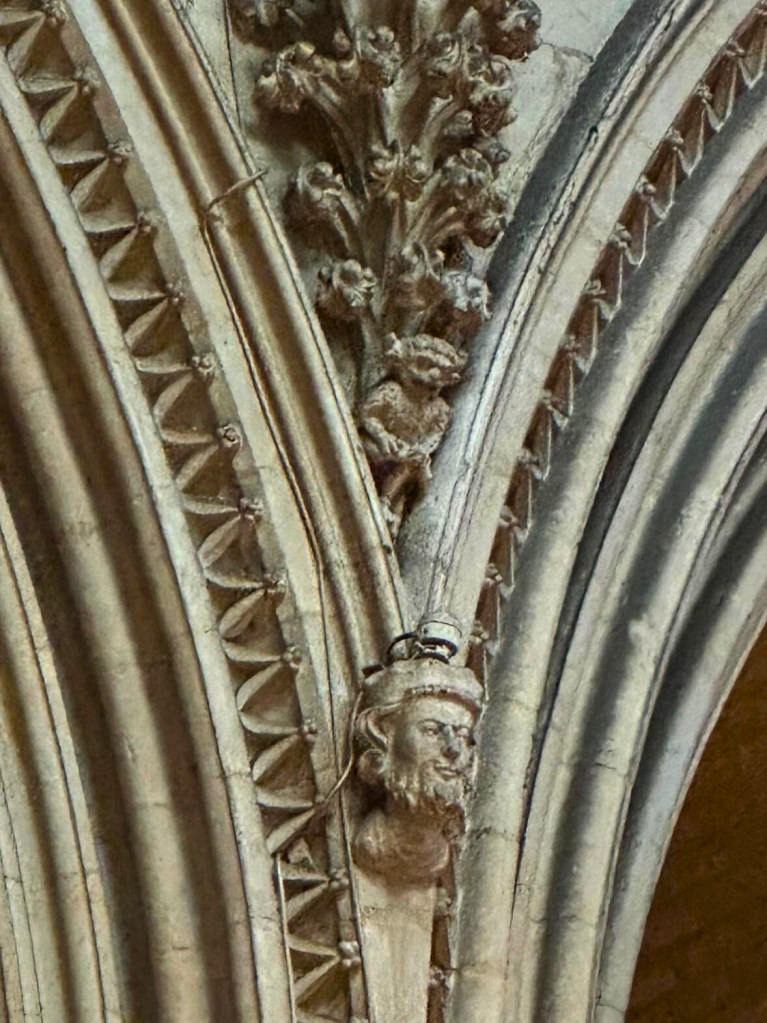
The Lincoln Imp is a late thirteenth-century cross-legged grotesque in Lincoln Cathedral’s Angel Choir, above the tomb of St Hugh, overlooking the altar. It is about thirty centimetres or twelve inches tall. As Jacqueline Simpson and Steve Roud note in A Dictionary of English Folklore (2000), the word ‘imp’ combines the meanings of child and small devil, which is an accurate description of his appearance; while grotesques are obviously common, nobody is quite sure why a demon – if that is indeed what it is – has been situated in what is surely the most sacred part of the building.
That mystery is perhaps why it has become the most famous bit of stonework in the county by some distance, though its fame was certainly spurred along in the late nineteenth century by the prominent Lincoln jeweller James Ward Usher, who made Lincoln Imp jewellery; in 1890, he acquired a patent meaning that, for a limited time, only James Usher & Son could produce jewellery using the Imp as a motif. You can see an original Lincoln imp brooch and a set of Lincoln Imp spoons in the Usher Gallery., and can still buy Usher Imp jewellery, made using the original moulds, at James Usher and Son near the Stonebow in Lincoln.
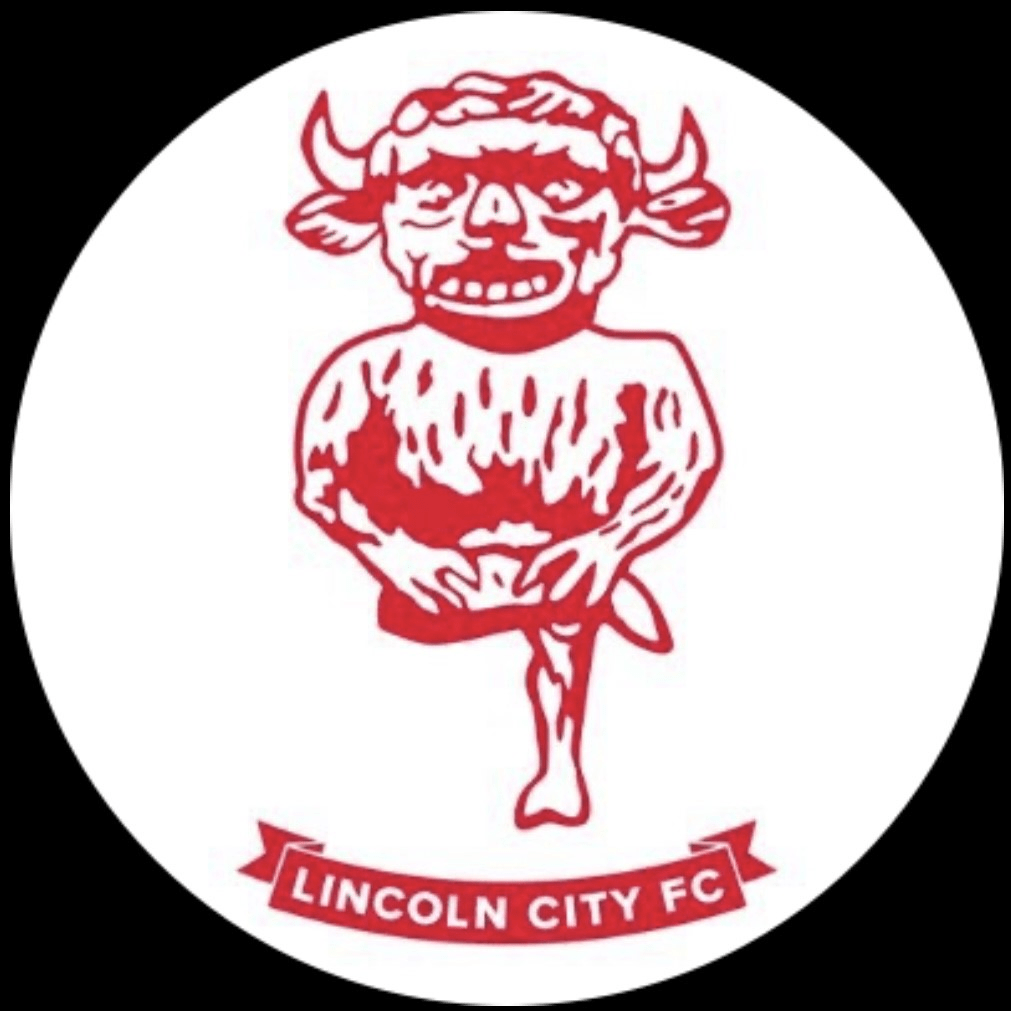
The imp design was subsequently used by many other businesses. The American car company Lincoln, for example, attached Imp mascots to bonnets (or, er, ‘hoods’) early last century. Many Lincolnshire shops and businesses use the name and/or image of the Imp, the County Council has adopted for its logo a stylised version of the Imp that appears to be dancing a jig, and the city’s professional football club, Lincoln City, is nicknamed ‘the Imps’ and uses the imp as badge and mascot (see below for a recent iteration of the club badge, now replaced with a more stylised alternative). Renditions of him are all over the city, and in 2021 he was the subject of Lincoln’s Art Trail. Almost any tourist shop in Lincoln will sell you a resin model of the little demon.
There are in fact two carvings at Lincoln Cathedral commonly regarded as imps, and several other impish figures; the far less famous of the two Imps is above an exterior door arch on the south side of the building, its arms around the head of a grotesque, and is very extensively weathered and currently under wrapping. This auxiliary imp has its own related legend: two imps travelled to Lincoln, and this one either waited or got stuck outside, so it rested on the back of a witch and both witch and Imp were subsequently turned to stone. In one more recent version of the story, another Imp ends up in Grimsby, and there is a very different-looking ‘Grimsby Imp’ in Grimsby Minster.
There are many versions and variants of the tale associated with the more famous Imp (some of which incorporate his external counterpart), and he remains a popular subject for storytellers of various kinds. In one account, he was borne to Lincoln on a devilish wind, which remains outside, and was turned to stone by angels for wreaking havoc. In another, the Devil was incensed that Lincoln Cathedral was being transformed into something close to the huge monument to Christianity that we see today, so he travelled there with his impish minions to attack it, but the Bishop prayed to fend him off, causing a divine and protective wind; one Imp found a way inside to shelter, and was turned to stone by the holiness of the building. In yet another, the Devil was friends with an evil dean, so he paid a visit, but was then turned to stone, leaving his windy transport outside for eternity.
The wind-related aspect of the tale may have origins in the Norse god Odin, often interpreted as a god of wind, and it is interesting to note that, as Mabel Peacock writes in the Preface to Examples of Printed Folk-Lore Concerning Lincolnshire (1908), ‘the story of the wind waiting outside the minster for the Prince of Darkness is also told of the Frue Kirke in Copenhagen’. Maureen James, in Lincolnshire Folk Tales (2013), mentions a similar legend attached to Coutances Cathedral in Normandy. A precis of one version of the tale is on the website of the Lincoln tourist board. There is no evidence that the legend of the Lincoln Imp is pre-Victorian, though, and guidebooks from as late as the 1880s that mention the grotesque do not refer to it as an imp at all.
Poetic versions of the tale by Albert Frost (1897) and H. J. Kesson (1904) are among the oldest known extant renderings of the tale. Frost says he was told the story by a man in his sixties, some time around 1890, and that this man had learned it from his father when he was a child. If this is to be believed, that means the tale was being told in about the late 1830s, and possibly much earlier, though there is no evidence to support this. Kesson’s version was republished by Ruddocks of Lincoln in 2019, and is available cheaply from the Cathedral shop in a beautifully illustrated edition. The original text is also available via Project Gutenberg. Rory Waterman includes a modernised adaptation in Come Here to This Gate (Carcanet, 2024). Most books of Lincolnshire folklore include a rendition of the tale, but Adrian Gray, Tales of Old Lincolnshire (1990) provides several.
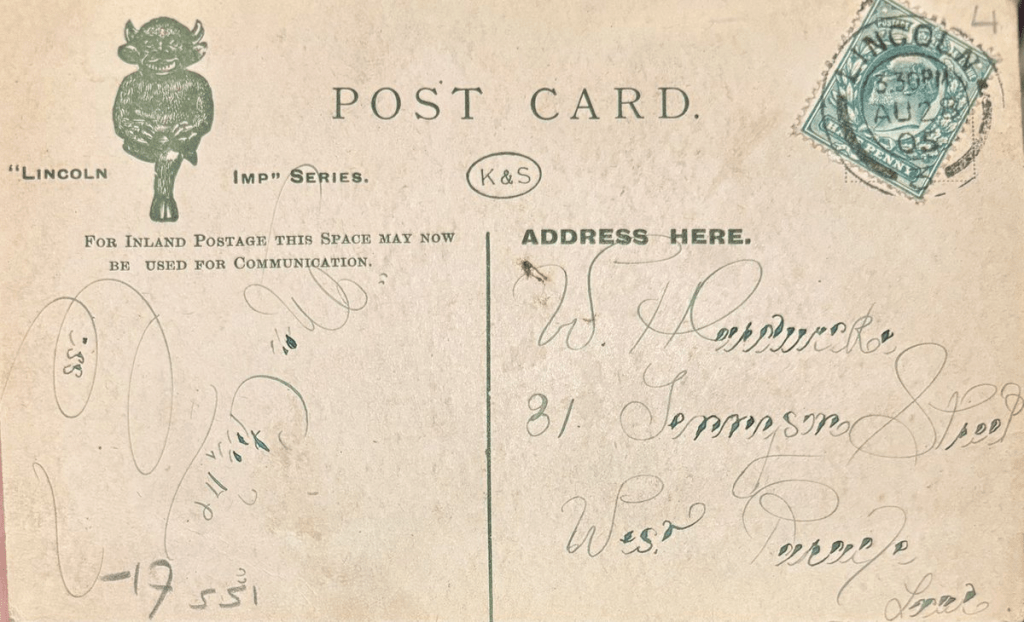
The Lincoln Imp has occasionally become a character, motif, or significant feature in other works of fiction. Sue Hampton’s The Lincoln Imp (2009), a children’s book, recasts the Imp as the mischievous supernatural friend of a little boy, who helps the lad to navigate the world before he is called away on the wind. In Priscilla Novy’s sadly out of print children’s novel The Lincoln Imp (1948), a motor yacht on the edge of the city is the eponymous hero: a young brother and sister come up from London to have a river-borne adventure with their gregarious Uncle Bill, who spends his life chugging along the Witham. However, the turning point in the story happens in Lincoln Cathedral: Bill stays outside to ‘look at the Devil overlooking Lincoln’, and the children take themselves into the building, where they overhear a plan to rob their uncle’s paintings from a warehouse – meaning, ultimately, that the kids can save the day. Novy’s narrator pauses her narrative in the middle, dedicating three pages to the tale of the Lincoln Imp. Cecil Dye’s Love and the Lincoln Imp (1925), sold in pamphlet form, follows the love interests of a twenty-two-year-old medieval sculptor called Saxby, who gets embroiled in a love triangle and carves the Imp from the ruins of a sculpture he has made of his love interest, Ruth, in order to get his own back on his fellow would-be suitor called Cedric who has claimed to have carved her himself. Ruth slaps Cedric, he tries to kidnap her, and then Saxby shoots him in the back with a longbow. The story ends with Saxby and Ruth in one another’s arms as the fatally wounded Cedric drowns in the River Witham.
In 2025, University of Lincoln BA Film Production student Eloise Allatt made this lovely short film about what the Imp means to people (including a brief cameo from LFT project lead Rory Waterman. The winner of the 2021 Write a Lincolnshire Song competition was Stonesthrow with ‘The Usher Imp’, available here at 52.50:
Just as this project ended (July-August 2025), the Lincolnshire-based folk musician Ruairidh Grieg put his own version of the legend, to an obscure nineteenth-century tune called ‘As Sure as the Devil’s in Lincoln’, on his YouTube channel: https://www.youtube.com/watch?v=b2I7hwW2UkU&t=128s.
Lincoln College (the one that’s part of the University of Oxford, not the one down Monks’ Road in Lincoln) was founded by Richard Fleming (1385-1431), Bishop of Lincoln, and Epworth native John Wesley was elected a Fellow of Lincoln in 1726. It is also home to its own sculpture of the Lincoln Imp, the first iteration of which (it weathered badly and has been replaced) was installed in late Victorian times, after the thirteenth-century original at Lincoln Cathedral had become famous.
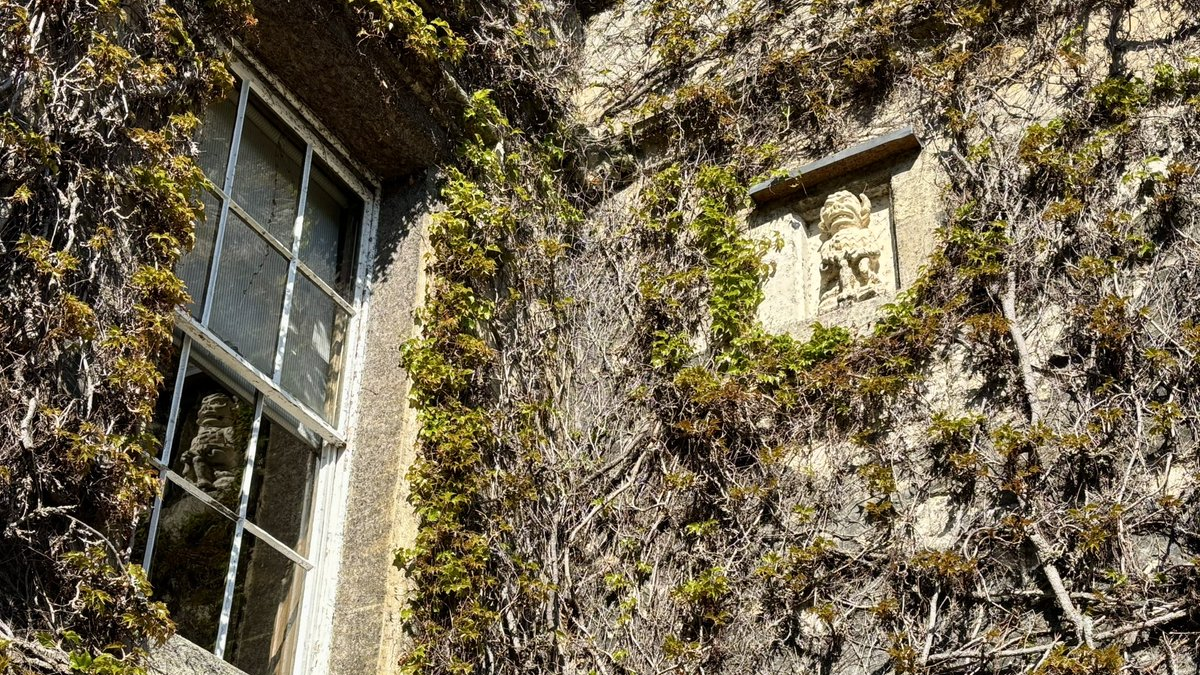
If you look down the street towards the Lincoln College, Oxford, you’ll be able to see another grotesque staring back at you, this time on the roof. This was installed in 2002, but copies an earlier equivalent that was removed about two centuries ago. It might be the origin of the saying ‘He looks as the Devil over Lincoln’, though that might equally originate with the second Imp at Lincoln Cathedral. The two look ‘over’ their respective Lincolns in different senses. Sources from the seventeenth and eighteenth centuries seem to favour Oxford, but that might be a result of that city’s and university’s almost unsurpassed cultural cache. We’ll never know for sure. The famous Lincoln Imp, however, certainly has its origins in Lincoln, from where it has flown (or perhaps hopped) around much of the world.
Words by RORY WATERMAN

 Lincolnshire Folk Tales Project
Leave a comment