

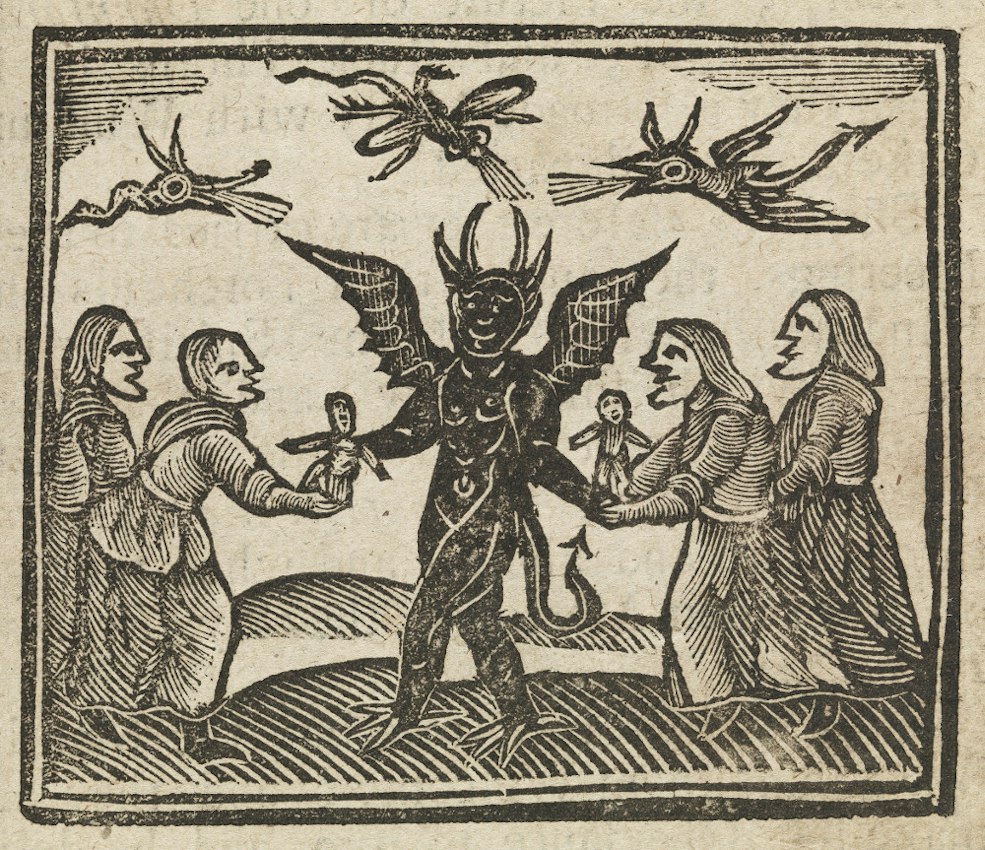
A beautiful young woman from near Louth, called Fanny and known as Fan o’ the Fens, lives with her widowed mother, who complains that a magpie keeps following her and repeating what she says. She consults the wiseman of Louth, who says the mother has been bewitched, and they call a meeting at her house, during which the wiseman says that when the cat that is sleeping by the fire then wakes it will sit on the shoulder of the guilty person. This transpires to be Fan, and everyone abandons her, including her sweetheart Simon, who soon finds a new beau. Simon subsequently puts on a lot of weight and doesn’t understand why, so he consults a wizard, who tells him that he too is under the spell of a witch. He says that the witch will be revealed later that day, because she will be on fire. As Simon returns home, he passes Fan’s house; she runs out screaming and covered in flames, and nearly dies. Simon subsequently loses weight, and soon he is back to his usual dimensions.
Fan is now very unpopular, of course. A neighbour tries to pass her house but his horse won’t move, so he mutters a curse about witches, which is overheard by Fan. Soon, he becomes gravely ill, and it is discovered that he has a large snake inside him, which is tempted out with a bowl of milk. He recovers.
It is believed Fan communes with the Devil on the nearby marsh during the full moon, so a band of locals decide to catch her in the act. The only snag is that if anyone sees this act of Devil worship taking place, they will die within a year, unless they are a wiseman. Therefore, the wiseman of Louth agrees to watch her house on the night of the next full moon. He hears witches chanting inside, then a window opens and several of them, led by Fan, fly out. He searches the house, and determines that they have indeed been worshipping the Devil in there. When the witches return at dawn, he knocks on the door, then storms in when she opens it, but all the other witches and signs of Devil worship have vanished. She is subsequently put on trial for witchcraft, but gets off due to a lack of evidence.
The locals decide mob justice is called for, so they take her to the river and threaten to drown her if she doesn’t confess to being a witch – which she does, of course, before they try to kill her anyway. She escapes, and they thrash at her with sticks, demanding she leave and never return. She is not seen again.
This is told by Christopher Marlowe in Legends of the Fenland People (1926), and retold by Susanna O’Neill in Folklore of Lincolnshire (1992), who stresses that it comes not from the Fens but from Louth – which is where Kathy Hipperston of Time Will Tell Theatre set the tale at the Lincolnshire Lore: Stories and Song event for this project at Grimsby Town Hall in September 2024. We have therefore tentatively located it close to Louth, on the fen-like Marsh, though there is no evidence whatsoever that it originated there. The tale possibly offers an insight into the spurious allegations of witchcraft that often led to harsher punishments in a great many places, and the zealous potential of social contagion. It may therefore seem to date to the seventeenth century, or earlier. However, it is not unlikely to be Marlowe’s invention. As the folk musician Ruairidh Grieg has pointed out in correspondence with this project (18 June 2025), Marlowe seems to borrow elements of the tale from various stories conveyed by James Alpass Penny in Folklore Round Horncastle (1915) and More Folklore Round Horncastle (1922). There is no record of the tale before Marlowe, which also raises serious suspicions about its origins. As such, we might consider it a folk tale only because people (including at least one folklorist and author, O’Neill) have believed that it is, and therefore it has become one, of sorts – a phenomenon that cannot be discounted for many folk tales. The much more famous legend of the Lincoln Imp is likely to be another example of this phenomenon.
Words by RORY WATERMAN

 Lincolnshire Folk Tales Project
Leave a reply to A Witch of Kirton in Lindsey – Lincolnshire Folk Tales Project Cancel reply