

Writing in the 1900s, the folklorist Mabel Peacock noted that ‘I have never found a district, nay scarcely a parish, that has not its stories of witches’ (Gutch and Peacock, 1908). Often, at least in extant sources, these amount to little more than a series of anecdotes, but some are fully-fledged tales, and this is one of those, which has also left its name on the map.
The hamlet of Byard’s Leap (on High Dyke, part of the Roman Ermine Street) is named for a local story about a witch called Old Meg, who lives in a cave (possibly in a nearby quarry) from where she terrorises – and in some renditions eats – locals, and curses their crops. She is challenged either by a villager, a knight or a retired soldier called Black Jim (different versions of the tale provide different heroes), who promises to slay her. He requires a horse, so goes to a pond where horses are drinking and throws in a rock to test their reactions. The first to raise its head is a blind horse called Byard. They head to Old Meg’s cave, and she tells the hero to wait outside while she suckles her cubs and buckles her shoes. She then creeps up on the hero and a fight ensues, in which (in non-sanitised renditions of the tale) he slices off her left breast, then swipes again and misses, and she digs her nails into Byard, who leaps sixty feet back towards the pond (in some variants he makes three leaps), the hero clinging to the saddle, and Old Meg attached to the rump. He then runs her through, and she is either killed by the blow and buried at a nearby crossroads under a slab and with a stake through her heart, or falls into the pond, never to return.
This tale has endless variants. Mary Borrows, in ‘Witches of Lincolnshire’, Lincolnshire Life (April 1986) provides a version of one common pretext for the main events, which tells how, late at night on Fulbeck Hill, a local farmworker called Sill ‘witnessed a rendezvous between the village witch Meg and her master the devil. Sill watched as the evil pair went through the village with horns of fire and brimstone in their hands, setting alight to the growing crops and killing the beasts in the fields. The next day he returned to the village to give his explanation of the disaster which had befallen the area. The villagers were terrified and resolved to put an end to Meg once and for all.’

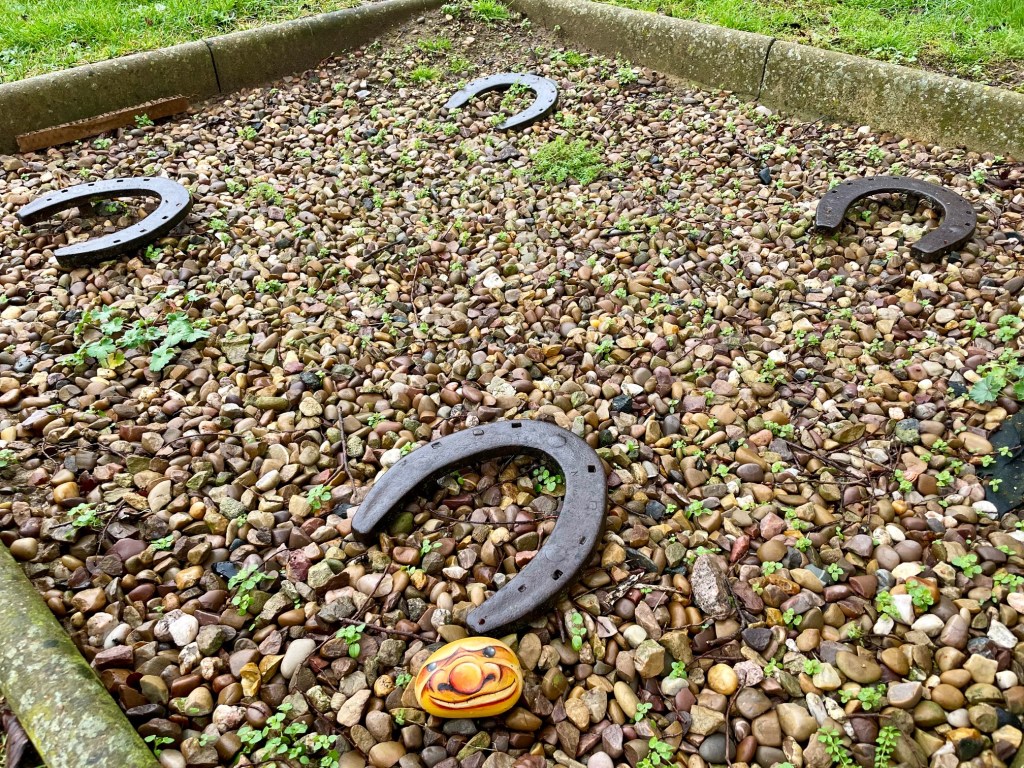
The places where Byard legendarily leapt were once marked by holes in the ground. In the mid-nineteenth century, these were replaced by horseshoes set in stone. In the 1960s, the A17 was straightened here, and one set was in the way of the new road, so it was removed, then eventually placed nearby. There is an information board next to it now, close to the Horseshoes Café and Lodge. A second set is on the grass in front of the garage. Any pond that used to exist nearby has vanished, though there is a shallow indentation in the small woodland across the A17, which may conceivably have been a pond at one time, and a dip next to the most southerly set of horseshoes that might once have been a pond. According to legend, Old Meg’s cave was under where the garage now stands. The mounting stone allegedly used by the rider on that fateful day is outside Byard’s Leap Farm, where the B6403 (on the route of Ermine Street) meets the lane confusingly named Roman Road.
Versions of the tale are fairly numerous, and include Ethel H. Rudkin’s, in ‘Lincolnshire Folklore, Witches and Devils’, Folklore 45.3 (1934), Christopher Marlowe’s, in Legends of the Fenland People (1926), and that in Bygone Lincolnshire, ed. W. Andrews (1891), included in Gutch and Peacock, Examples of Printed Folk-Lore Concerning Lincolnshire (1908), which is available to read here.
A very enjoyable version if the tale, which deviates from the above renditions by having the witch dig her nails into the hero and nearly kill him, is told by Adrian Gray in Tales of Old Lincolnshire (1990). Michael Wray includes a ghostly retelling in 13 Traditional Ghost Stories from Lincolnshire (2003). The folk-rock group Decameron included a musical adaptation of the tale on their album Say Hello to the Band (1973). The most recent piece of music associated with the tale is probably an instrumental recorded by The Shackleton Trio in 2022.
Bayard, a very likely inspiration for the tale, is a strong, intelligent and indeed magical horse in several Medieval French narratives from the twelfth and thirteenth centuries. The word ‘bayard’ became a synonym in English for stupidity and recklessness, though this had largely died out by the seventeenth century. In ‘The Canon Yeoman’s Tale’, Chaucer writes ‘Ye been as boold as is Bayard the blynde. / That blondreth forth and peril casteth noon.’
You can listen to a section of The Shackleton Trio’s ‘Byard’s Leap’ below:
Words and images by RORY WATERMAN


 Lincolnshire Folk Tales Project
Leave a reply to Meg’s Island – Lincolnshire Folk Tales Project Cancel reply