


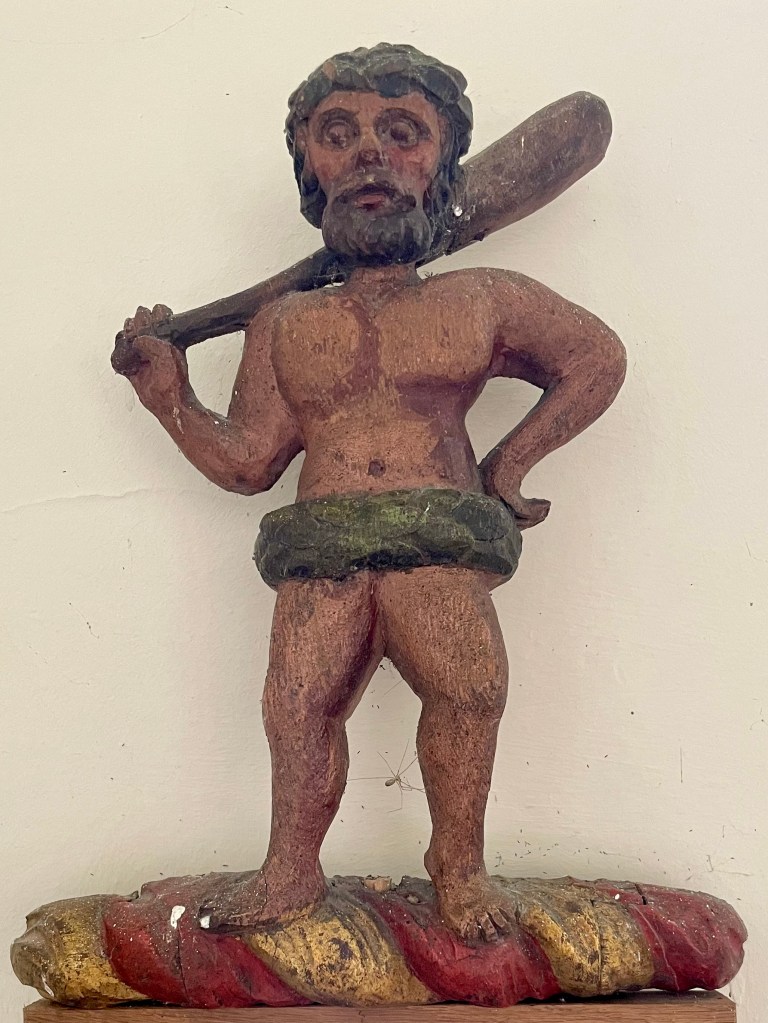
Legends of wild men of the woods, or wodewose, are not uncommon in medieval literature across much of Europe, and have parallels in many other cultures, such as Bigfoot/Sasquatch in North America. The Wild Man of Stainfield is an alluring local example, and easily the best known and most widely discussed in modern Lincolnshire. He allegedly once lived in the woods near Stainfield, north of Bardney, and would make raids to kill the locals and their livestock, though in truth his legend likely came to Lincolnshire only in the heraldry of a family who turned up in the seventeenth century.
The tale concerns – or perhaps should properly concern – the Tyrwhitts, who were granted Stainfield Priory by Henry VIII following the Dissolution of the Monasteries. A wild man has appeared on the Tyrwhitt family crest since 1541. The Drake family took on the property in about 1751, and changed their name to Tyrwhitt-Drake, and it is possible a tale of heroism concerning a wild man in and around Stainfield was put about, or at least adapted, to suit their interests.
Despite its obvious age, the first written accounts of the legend date only from the early twentieth century. The most detailed of these, and the most common source for modern accounts and retellings, was collected by James Alpass Penny in his book Folklore Round Horncastle (Morton & Sons, 1915), which was published in an edition of just 100 copies and is long out of print. Modern discussions of the legend are fairly common, e.g. in Daniel Codd, Mysterious Lincolnshire. Rory Waterman talks about the legend in this episode of BBC Secret Lincolnshire (and accidentally says fifteenth, not sixteenth, century – but never mind).
Many variations of the tale exist. In one, the wild man is a local nobleman who returns from fighting in the Crusades to find he has had his land and property stolen. He takes to the woods with his mind bent on vengeance, terrorises the neighbourhood, and is then killed by Francis Tyrwhitt-Drake – even though Tyrwhitt-Drake only came to Stainfield several centuries after the Crusades.
In another version, Francis Tyrwhitt-Drake finds the wild man asleep, and plunges a dagger into him, receiving substantial local lands in return, and it is sometimes said he took the name Tyrwhitt, a regional (and onomatopoeic) term for a lapwing, to honour the bird cry that had indicated the wild man’s location. This is further appropriation. A Tyrwhitt family legend has it that an ancestor acquired the name after being injured while defending a bridge; he was discovered lying in nearby rushes because lapwings were crying out over the spot where he lay, and allegedly took the name Tyrwhitt thereafter to honour their role in his rescue.
A further variation of the tale is that a band of local farmers known as the Hardy Gang, angry that livestock keeps being stolen and their families terrorised, hunts the wild man down between Stainfield and Langworth, a wood between which is now called Hardy Gang Wood.
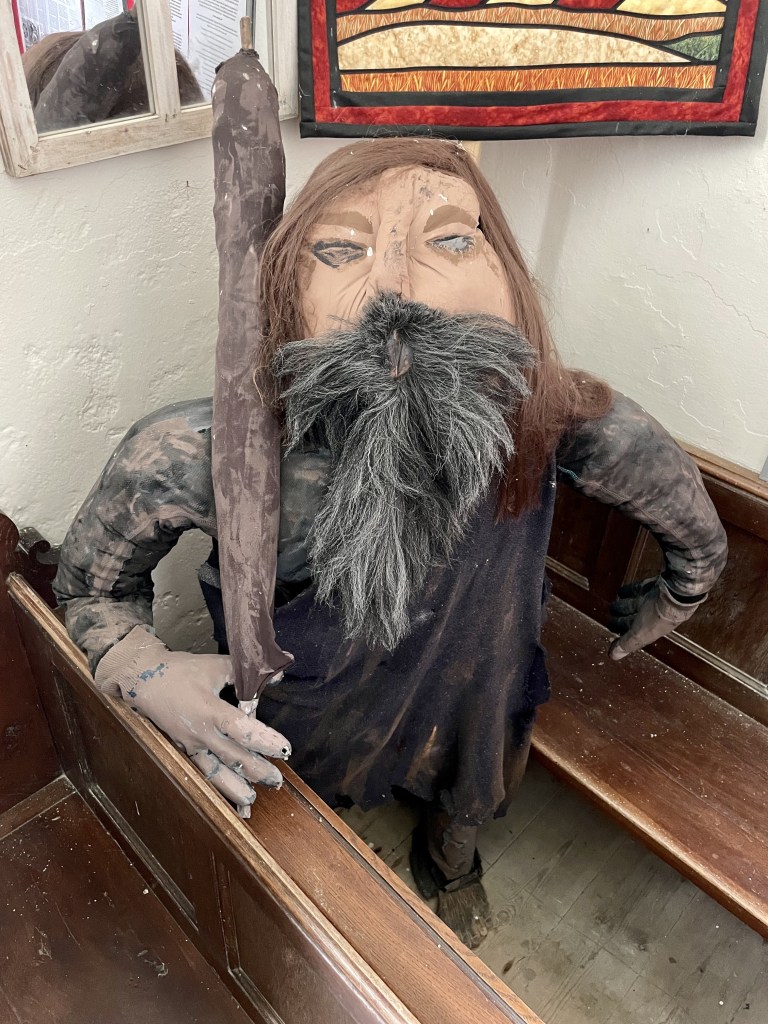
There are effigies of the wild man and a display of relevant magazine clippings in Stainfield’s unusual eighteenth-century church, which used also to house what were supposed to be the rags he had worn and the dagger, gloves and helmet of the man who killed him. They were stolen in 1995. There is another wild man associated with the Tyrwhitts in a Lincolnshire church, though. The tomb of Sir Robert Tyrwhitt (1526-81) and his wife Elizabeth Oxenbridge, in All Saints’ in the village of Bigby near Brigg, features a wild man and the couple’s 22 mourning children, including several who died in infancy, symbolised by cribs.
Thanks to Reggie Tyrwhitt for providing contextual information regarding his family.

Words by RORY WATERMAN


 Lincolnshire Folk Tales Project
Leave a reply to The Origins of the Wild Man of Stainfield? – Lincolnshire Folk Tales Project Cancel reply