

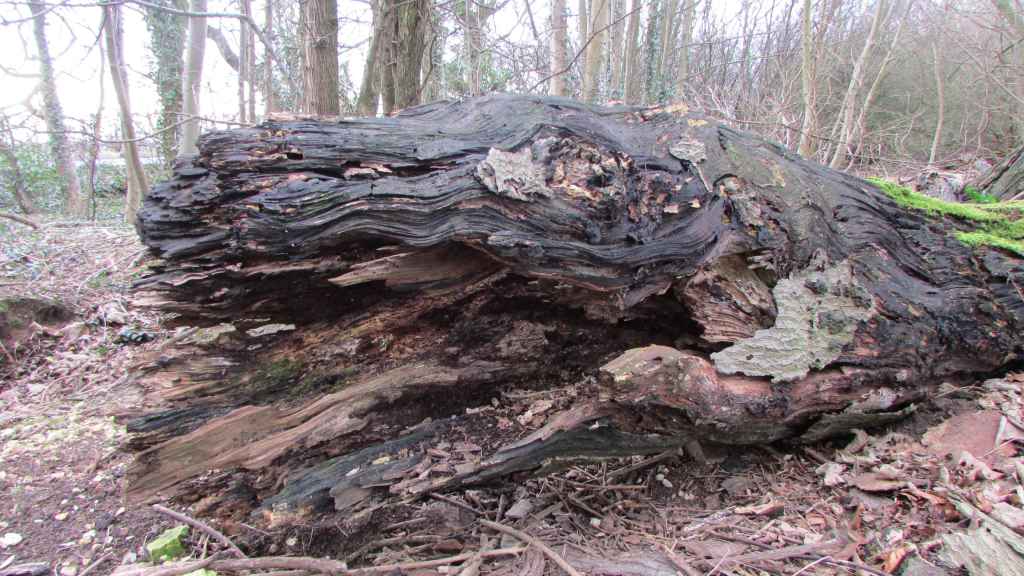
Castle Carlton is an atmospheric moated earthwork in woodland with a public footpath skirting it: all that remains of a medieval motte and bailey castle. The legend of Sir Hugh Bardolph, set in the twelfth (or in some cases the thirteenth) century, recounts the slaying of a man-eating dragon with one eye (perhaps unique in British folklore) at the site, during a storm. The dragon is too nimble for the hero, but fortunately a bolt of lightning (in some versions the divine intervention of St Guthlac) eventually blinds it, and Bardolph fatally stabs the creature in its only weak spot, a wart on its right leg.
This tale is retold in Susanna O’Neill, Folklore in Lincolnshire (2013), Adrian Gray, Tales of Old Lincolnshire (1990), and Polly Howat, Ghosts and Legends of Lincolnshire and the Fen Country (1992). The Lincolnshire folk music duo The Devil’s Elbow have an exceptional song about the legend, ‘The Dragon of Castle Carlton’, which you can listen to here. (Thanks to Denise from The Spirit of Sutterby for telling us about this.)
Hugh Bardolph (sometimes Bardolf or Bardulf) was likely a real person, possibly either the Lord of Waddington of the late twelfth century or the Lord of Wormegay who died early in the fourteenth century. Whatever his presence in history, Sir Hugh has long passed into folklore, and his struggle with the dragon is mentioned as early as 1586, in William Camden’s Britannia. The folklorist Jacqueline Simpson (1978) refers to Camden, and notes that the Middle Ages were a key formative period for dragon narratives of this type. Simpson continues that some elements of the tale, like the single vulnerable spot on the dragon and the dragon-slayer’s subsequent elevation in status, are motifs recognisable from elsewhere.
Ethel Rudkin (1955) records a dragon legend connected to Walmsgate, five miles south-east of Castle Carlton, though it does not mention Hugh Bardolph:
There is a Long Barrow on the roadside at Walmsgate, in the Wolds; locally the name is pronounced Wormsgate, and it is said that once, long ago, three Dragons lived in the neighbourhood, devastating the land. An unnamed hero took arms against them. He slew one, and it is buried in the long mound-this accounts for the name Wormsgate. AnotherDragon flew away towards the Trent, but did not succeed in crossing that river. It settled down in Corringham Scroggs, a flight of some 35 miles; the place was known as Dragon’s Hole ever after; in fact, it is mentioned in the late Enclosure Award of 1852. The third Dragon was fatally wounded, and crept away and died at the next village of Ormsby, which they say was once Wormsby.
In Gutch and Peacock (1908), South Ormsby is also connected with Hugh Bardolph and dragon-slaying, giving a further hint that this is one legend modified through the years by various tellers. Click here to read about a monstrous serpent that terrorised the village of South Ormsby.
There are very many similar stories of gallant dragon-slaying popular across England, of course, including St George and the Dragon. An intriguing and more properly native counterpart is the Dragon of Mordiford, Herefordshire. International counterparts are almost overwhelmingly numerous, but considering the high proportion of people in Lincolnshire who have Polish heritage, we’d like to make special mention of the Wawel Dragon (Smok Wawleski), one of the most famous tales in that folk tale-rich country.
Words by RORY WATERMAN

 Lincolnshire Folk Tales Project
Leave a reply to The Serpent Slain at Walmsgate – Lincolnshire Folk Tales Project Cancel reply