

Dr Anna Milon
Anna was the Postdoctoral Research Fellow on the Lincolnshire Folk Tales Project throughout its AHRC-funded duration, from February 2024 until July 2025. She is now a Postdoctoral Research Associate on Project StoryMachine, so this is a ‘guest post’, but also not quite a guest post!
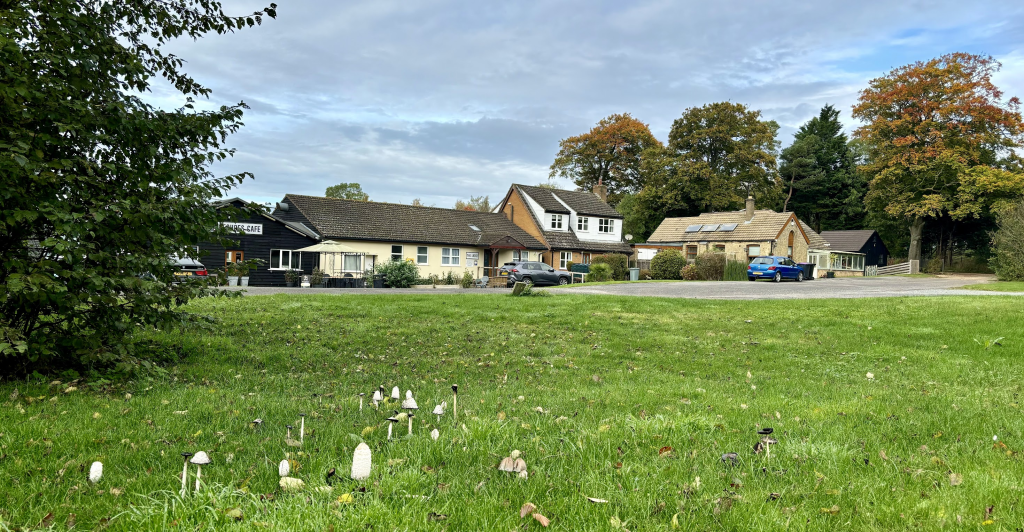
The hamlet of Byard’s Leap, just off the Newark to Sleaford stretch of the A17, is no chocolate-box village. But it is a great example of the use of folklore mapping. Named after the prodigious leap of a folktale horse, the Leap is a node from which connections branch out across landscape and across time.
Rory Waterman detailed the hamlet’s and the tale’s geographic situation in his inaugural professorial lecture at Nottingham Trent University in early March 2026. The story starts with a witch, Old Meg, who causes mischief for locals, and a local man (an aged knight or a farmer) who takes it upon himself to put an end to her. The witch lives in a cave some distance away, so the man goes to choose a steed to bear him thence by chucking a stone into a pool where some horses are drinking. The first to raise his head is Byard, in some cases the man’s old war-horse, and he and his rider set off to fight the witch.
When they reach Old Meg’s cave, she tells the hero to wait outside while she suckles her cubs and buckles her shoes. She then creeps up on the hero and a fight ensues. The witch digs her nails into Byard, who leaps sixty feet back towards the pond (in some variants he makes three leaps), the hero clinging to the saddle, and Old Meg attached to the rump. He then runs her through, and she is either killed by the blow and buried at a nearby crossroads under a slab and with a stake through her heart, or falls into the pond, never to return.
The tale has and clearly also had multiple variations, some sadly unrecorded, others discussed in our blog (link here). Despite Byard’s Leap arguably being the place where it happened, versions of the story were mentioned as far away as Burgh le Marsh and Willoughton by folklorist Ethel Rudkin. Byard himself, or his possible narrative predecessor, is even more far travelled. In English sources he is an old, blind and none-too-wise nag, but in some French romances he is a supernaturally strong, talking and… extendable horse capable of carrying all four Sons of Aymon at once. (Some Kelpie stories also have that horse-creature unfold like a concertina to accommodate more riders – just saying.)
Byard’s Leap sits on the High Dyke, the former Roman Ermine Street, and may have witnessed the transportation of alleged witches Margaret and Phillipa Flower to their trial in Lincoln in 1618. This may have cemented the notion that there really were witches in those parts and ensured the tale’s endurance.
Thus, where Byard’s Leap lies geographically and psychogeographically is valuable for understanding the folk tale’s evolution and integration into the landscape. The above is all explored in a chapter of Waterman’s new book.
Meanwhile, I now tackle maps of a different kind. At the end of my contract with Nottingham Trent University to work with Rory on the AHRC Lincolnshire Folk Tales Project, I moved to Project StoryMachine, a multi-institutional endeavour to build an interactive digital folklore tool, sponsored by the AHRC and the DFG. The tool, called StoryMachine, aims to foster a deeper engagement with British and German folktales. One way it does so is through the use of spatial hypertext, a non-linear representation of information in digital space (think mind-map on steroids). Spatial hypertext allows users to interact with many elements of folklore without dictating relationships between them. Everything is connected, but the connections are fluid and capable of change. Spatial hypertext in a digital space provides an easier way to navigate and alter relational pathways between folktales.
For example, a user of StoryMachine who has heard of Byard’s Leap and would like to explore how it fits into wider folklore trends might discover a link to stories where horses act as supernatural helpers, aiding their riders in completing impossible tasks. These tales are classified in the Aarne-Thompson-Uther motif index as ATU530 and ATU531, which include such gems as a five-inch-tall humpbacked horse helping his rider emerge unscathed out of a vat of boiling milk.
I promise that no milk has been boiled in the making of StoryMachine. And you can follow the project’s developments on the website StoryMachine or by searching for Project StoryMachine on LinkedIn, Bluesky, or Mastodon.
You can read another new blog post by Anna on the Project Storymachine website here.
 Lincolnshire Folk Tales Project
Leave a comment