

There was a man in our town and [Mr B.] was his name.
He’s been beating his poor Wife and don’t you think it’s a shame.
And if he does the likes again, as I suppose he will.
We’ll sit him on Dicky Billy, and ride him through Foldhill.
This short poem was kindly shared with us by Phil Hoeft, who heard it from his Father in law. He, in turn, hailed from Fiskney, between Boston and Skegness, which indeed has an area called Fold Hill. “Dicky Billy” is thought to be a chair tied to a ladder which would be carried through town by the local menfolk.
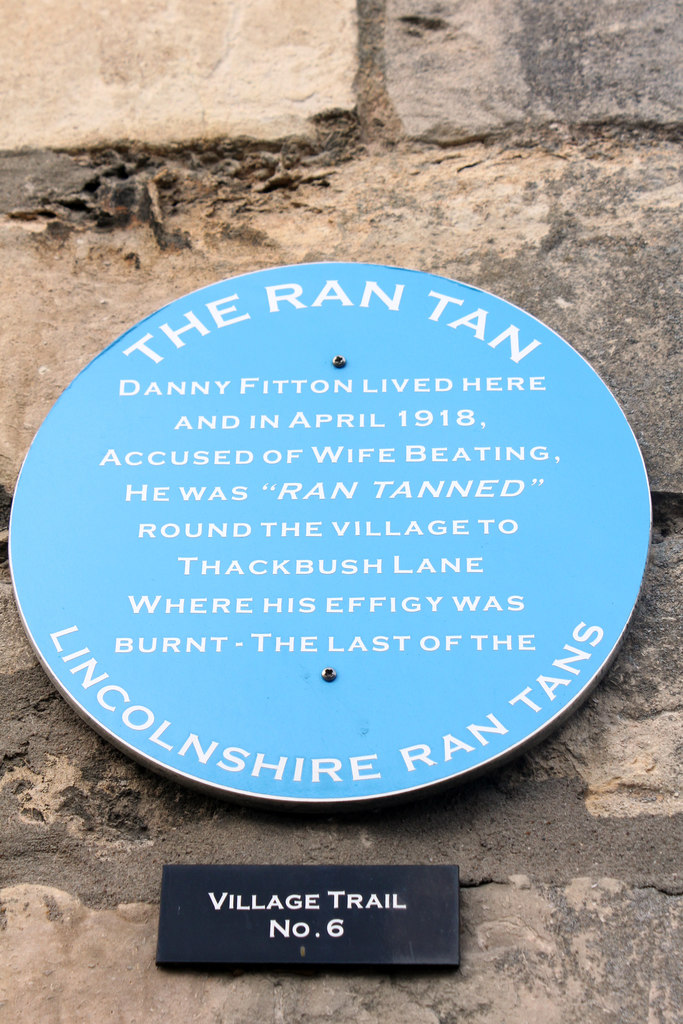
The poem refers to Ran-tan-ning or Ran-tan-tan, an onomatopoeically-named custom of delivering folk justice to disproportionately violent members of a community (here, a domestic abuser). Ethel Rudkin records it in Holton-le-Clay, Langwith and Willoughton, and the process goes something like this:
If a man offended a community by violent behaviour, its members gathered old pots and pans, sheet iron, and anything that makes noise, to make a racket and sing outside the man’s house, often three nights in a row. At the end of the third night, an effigy of the offender was made out of straw and clothing, and solemnly burnt by the ran-tanners.
Rudkin also records a Riding the Stang poem in Winterton, which describes a similar practice:
“Ran-a-dan, ran-a-dan, ran-a-dan-dan,
I ride the stang for this base-hearted man.
He neither took stick, stake, nor stower,
But ‘e upp’d wi’ ‘is fist an’ ‘e knocked ‘er ower.”
Words by ANNA MILON, with information by Phil Hoeft
We are grateful to Phil Hoeft for bringing the poem to our attention.
Edit: Anna Milon discusses the practice in an article in the October 2024 issue of Lincolnshire Life.
 Lincolnshire Folk Tales Project
Leave a comment