


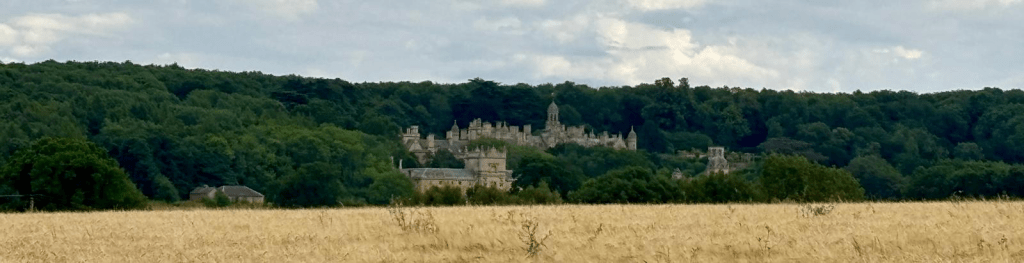
Most sightings of ghosts amount to memorates – not quite really folk tales. Perhaps one might regard clusters of sightings that seem to feed one another and that are often discussed together as fully-fledged folk tales of a sort, though we realise we are stretching the definition a little here. In any case, in the mid-twentieth century Harlaxton Manor – built to rival Belvoir Castle – was in the care of Jesuits, who reported many supernatural events, resulting in a well-publicised exorcism. Perhaps the most unnerving ghost story at Harlaxton concerns the alleged ghost of a woman with a baby, linked to an unverified anecdote that concerns a woman falling asleep in the Clock Room and accidentally tipping the infant on her lap straight into the open fire. This is discussed by Camilla Zajac in Lincolnshire Ghost Stories (2017).
Prior to the Jesuits’ exorcism, the manor was owned by self-made millionaire Violet van der Elst, who was convinced of her own skill in mediumship, held seances to contact her second husband, and had an occult library of over three thousand titles.
In Examples of Printed Folk-lore Concerning Lincolnshire (1908), Eliza Gutch and Mabel Peacock recorded the presence of two stones, seven feet apart, fifty yards south-west of the present Manor, one engraved ‘BILL’S LEAP 1633’. Local legend suggested they marked where a man had jumped for joy between these two positions when King Charles I stopped by on his way to nearby Belvoir Castle. They appear no longer to exist – at least we were not able to find them.
Words by RORY WATERMAN

 Lincolnshire Folk Tales Project
Leave a comment