


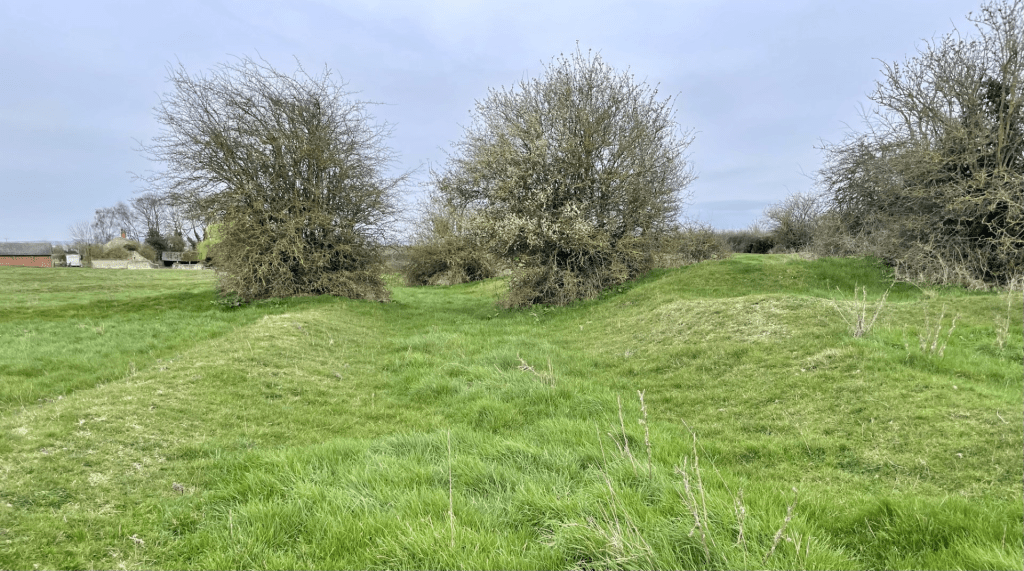
Lincolnshire is full of deserted medieval village sites, one of the best preserved of which is Gainsthorpe, now in the care of English Heritage. As Jim Snee notes in this beautiful blog post, which contains fact as well as fable, ‘According to legend, Gain[e]sthorpe was not just a village but a nest of robbers, and one fateful night the people of the surrounding villages rose up against it and burned it to the ground.’ Heritage Lincolnshire has its own post about the village here.
A detailed variant of the tale was collected by the local folklorist Ethel H. Rudkin, in her private diary entry for 1 August 1930. Her diary is now available to buy, in four volumes. The editor, Robert Pacey, notes that the account Rudkin provides ‘is a verbal, handed down version’ of that in The Diary of Abraham de la Pryme (1859). In the rendition Rudkin claims to have been told, one Tom Sturr, who is courting a girl at Staniwells Farm nearby, saw robbers advancing as he made his way across the fields, so he hid, and from his vantage point he saw them murder a rich captive merchant from Hibaldstow, and heard their plans. The robbers spotted him, and let him go on the promise that he would not tell anyone. Instead, he headed to the nearby villages, raised a militia, and headed to Gainsthorpe. ‘The robbers had the best of it for a long time, but finally they were driven to a last stand at the church, and the soldiers burnt the church down on them and rased the whole village to the ground.’
And you won’t find THAT on any of the English Heritage signs around the site…
Words by RORY WATERMAN

 Lincolnshire Folk Tales Project
Leave a comment