


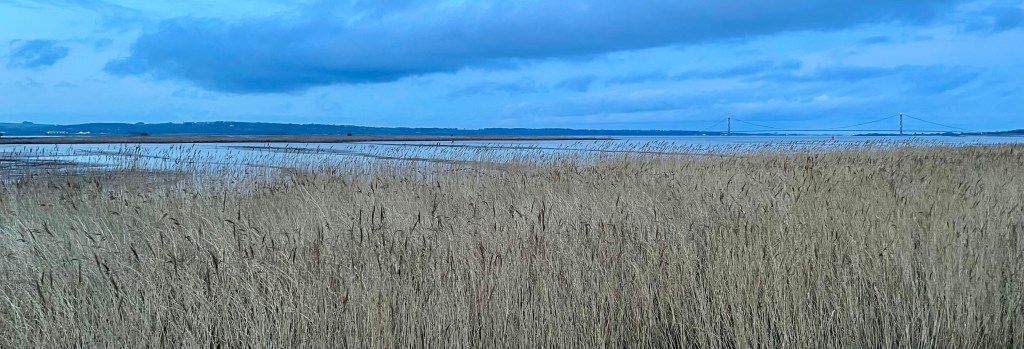
This is the story of a man who is said to have set himself up as a ferryman on Read’s Island ‘about 400 years ago’, and allegedly killed and ate many of his passengers. At trial, he is said to have taken on the form of a wolf, and it was reported that hundreds of human bones had been discovered on the island. This is recounted by Daniel Codd in Mysterious Lincolnshire (2007) and by Lucy Wood in The Little Book of Lincolnshire (2016), among others.
Read’s Island is now an uninhabited and uninhabitable nature reserve, visible from Winteringham Haven and South Ferriby. However, the island does show signs of past human activity. The earliest mention of Read’s Island seems to be in the Customs Map of 1734, where it is shown as a sandbank called Old Warp (potentially after the practice of ‘warping’, manoeuvring a turbid river to deposit a layer of silt in a desirable location). Towards the end of the century, grass was seen growing on the island in large enough quantities to support cattle. It has been occupied by humans at several points, such as in the 1860s when a sheep farmer called William Foster lived there with his family. The island has also served as a bird-shooting reserve. The last permanent occupier moved away in 1989, and all permanent structures, threatened by erosion, have since been demolished.

RORY WATERMAN AND ANNA MILON (not depicted above, thank you)


 Lincolnshire Folk Tales Project
Leave a comment