


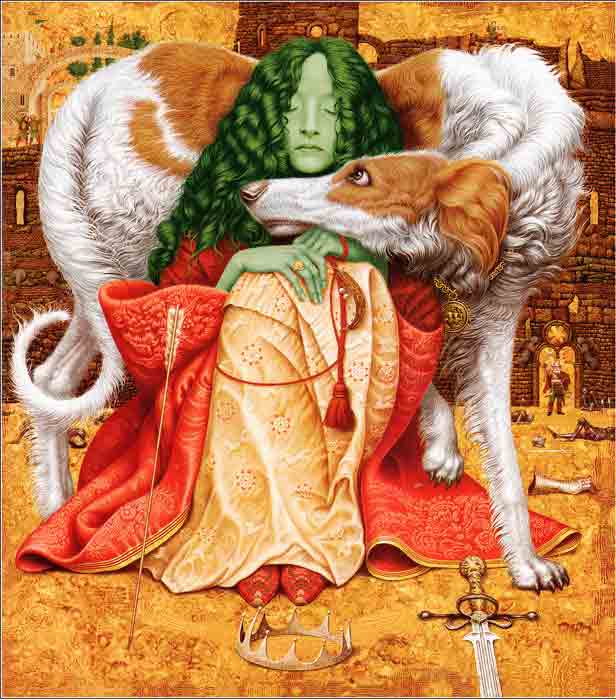
A famous ghost story involving Sir John Bolle (1560-1606), his residence of Thorpe Hall on the western edge of Louth, and a Spanish heiress called Donna Leonora Oviedo. According to the legend, Bolle was duty-bound to protect Oviedo, who had been taken prisoner during Sir Walter Raleigh’s 1596 raid on Cadiz, and they fell in love. She apparently pleaded with Bolle to take her back to England and marry her, and eventually he confessed that he was married already, so must refuse. She gave him her jewellery, as a present for his wife, and a small portrait of herself in a green dress (or, in some versions, drawn in green), asking him to hang it at home. He returned to Louth, and Donna Leonora is said to have subsequently become a nun and to have died heartbroken in a convent. Her ghost was then apparently seen on many occasions in the vicinity of Thorpe Hall, often in and around a specific tree, and the Bolle family would have a place set for her each mealtime.

Polly Howat tells the tale in Ghosts and Legends of Lincolnshire and the Fen Country (1992), as do Daniel Codd in Haunted Lincolnshire (Tempus, 2006), Lucy Wood in The Little Book of Lincolnshire (2016), and Camilla Zajac in Lincolnshire Ghost Stories (2017), who all provide brief historical summaries. Michael Wray includes it in 13 Traditional Ghost Stories from Lincolnshire (2003).The tale (or at least all of it up until their parting and her promise to retire to a nunnery) bears a remarkable resemblance to that told in ‘The Spanish Lady’s Love’, which was collected in Thomas Percy’s Reliques of Early English Poetry (1765), one of the first significant compendiums of ballads in English.
Words by RORY WATERMAN

 Lincolnshire Folk Tales Project
Leave a comment