

In the folklore of northern England, a hob-thrust (or hob-hurst, or hob-thrush, or hob) is a coarse, hairy, diminutive being, a goblin, capable both of malevolence and beneficence, especially as a worker on a farm.
One morning, so this story goes, a farmer in East Halton got up early to bring his sheep to the barn for shearing – a task he had meant to do the night before – and noticed they were already in there, with a hare among them. He looked up to see a hob-thrust on one of the roof beams, complaining that the grey ‘sheep’ had been harder to round up than all the others. The farmer gratefully promised to give him a linen shirt every New Year’s Eve, and in return the hob undertook tasks for him around the farm at night – occasionally getting up to mischief, but generally not. One year, however, the farmer decided to leave him a sack-cloth shirt instead of linen, and the hob-thrust was then heard chanting that ‘Thrift may go, bad luck may stay, / I shall travel far away.’ This he did, never to be seen again, and the farm subsequently fell into decline.
A helpful household sprite is often referred to as a brownie, and Jacqueline Simpson and Steve Roud, in A Dictionary of English Folklore (2000), refer to this story in their entry for that term. Maureen James tells this tale in Lincolnshire Folk Tales (2013), from a source collected by the Lincolnshire-based folklorist Ethel Rudkin and included in her book Lincolnshire Folklore (1936). Writing in the journal Folkore in 1901, Mabel Peacock notes: ‘The Scotch Brownie and the Yorkshire Robin-Round-Cap have at least one kinsman in the parts of Lindsey. He is known as the Hob-Thrust, and he has attached him self to a house in the parish of East-Halton.’ She goes on to say that ‘the stories which are generally related of his northern relatives are told of him too, but he is distinguished by one idiosyncrasy. He may always be made to “walk” by stirring the contents of an iron pot in the cellar, which pot is supposed to contain “children’s thumb-bones.” This idea connects him with the ordinary ghostly world, for I have it on the authority of a Lincolnshire girl that “th’ waay to be shut o’, ghoasts is ta get ’em under iron pots.”‘
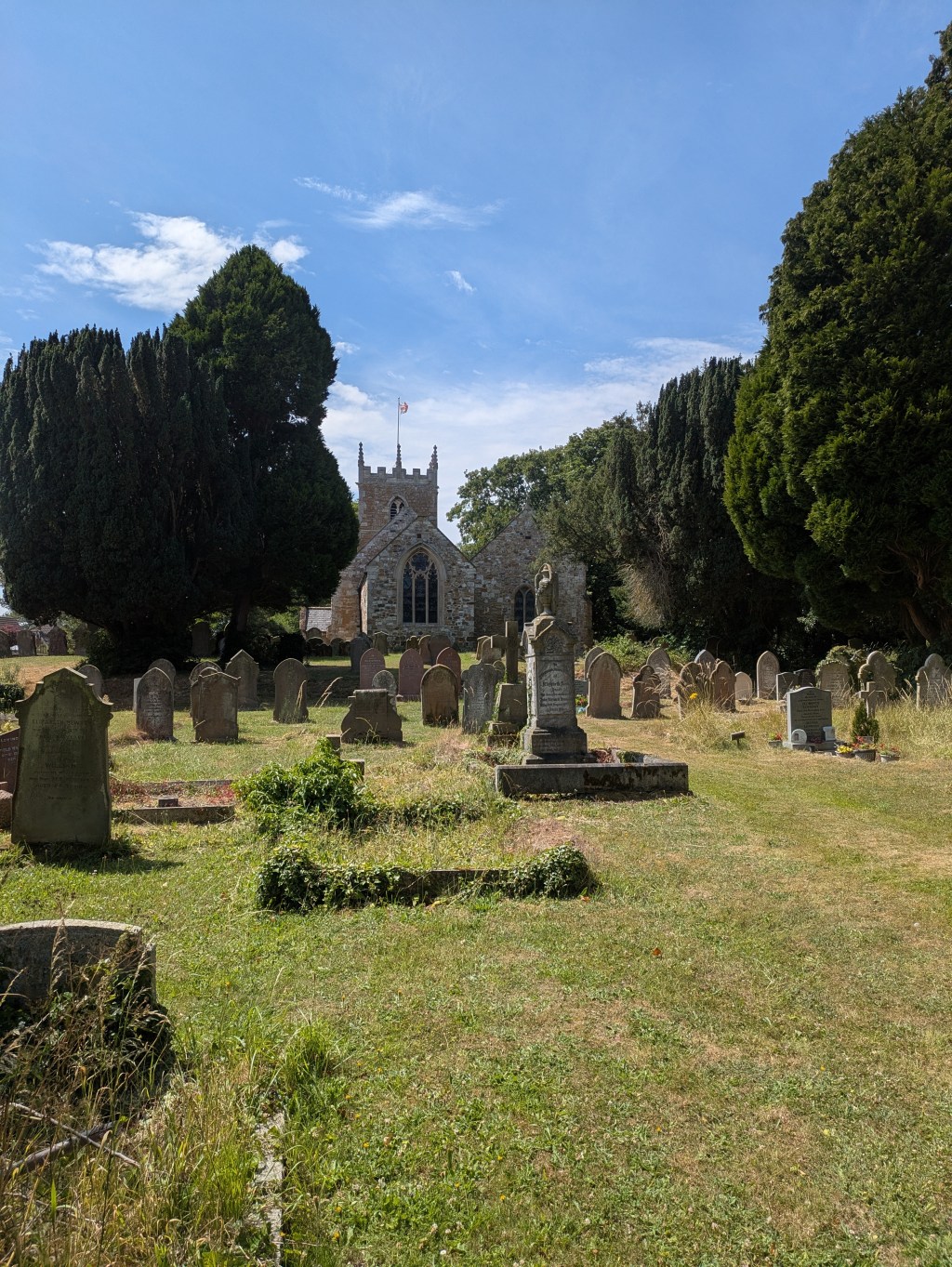
James adds that the East Halton hob-thrust is connected to other more local stories. One tells of how the villagers tried to build a church, but at night the hob-thrust would destroy their work, so in the end it had to be built south of the village. (The farm can’t be visited, but St Peter’s church a mile south of it can, where the pin for the tale is placed; a comparable story concerns the church at Dorrington, which also has an entry on the Folk Tale Map). James also tells of how, when Ethel Rudkin visited Manor Farm in 1932, she was told it had been haunted and that the inhabitants had placed an iron pot in the cellar, ‘and the malevolent spirit “laid” in it with a covering of pins and earth’ – iron having been believed to thwart the progress of supernatural and demonic beings. (Again, this is included in Rudkin’s Lincolnshire Folklore.) In the 1970s, workmen apparently refused to go near it, and the cellar was bricked up, so presumably it is still there. Dr Caitlin R. Green discusses the hob, and this legend, in this excellent blog post from November 2020.
Words by RORY WATERMAN
 Lincolnshire Folk Tales Project
Leave a comment