

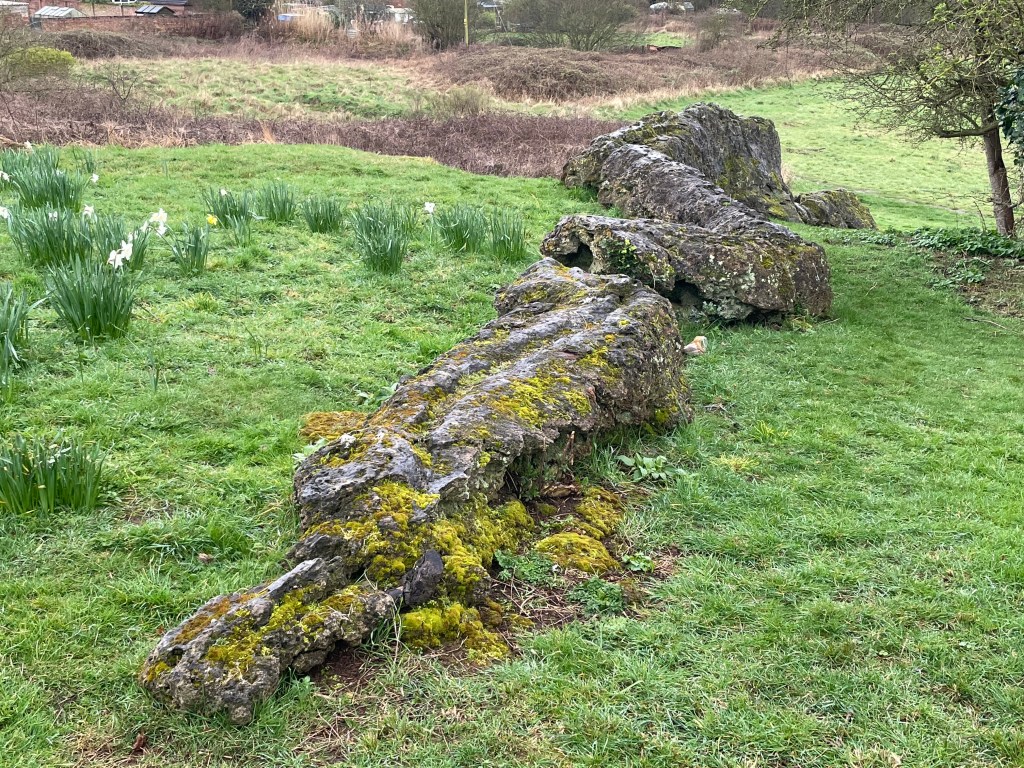
The Dragonby ‘Dragon’ is a natural limestone formation, about twenty metres long, with a discernible ‘head’ and ‘tail’. Its immediate vicinity is lovingly maintained, and it can easily be visited by walking for about a minute beyond a metal gate at the end of a short lane between houses on the north side of the street through Dragonby, though there is no signpost. According to legend, the formation is the body of a dragon, turned to stone by a wizard. At some point lost to history (but not recent) a line was scored along its ‘back’.
From at least the seventeenth century, until at least the late nineteenth century, the feature was known as ‘the sunken church’, allegedly sinking due to the preaching of Catholicism, and taking its congregation with it; it was claimed the bells could still be heard ringing on the anniversary of this ‘divine’ intervention. Gutch and Peacock, in Examples of Printed Folk-Lore Concerning Lincolnshire (1908), quote William White in 1882 describing it as ‘a mass of stone, called Sunken Church’ near Risby, that was, according to tradition, ‘a church attached to one of the monasteries in this neighbourhood’. Abraham de la Pryme also mentions it in 1696, and expresses some disappointment at determining that it is, in fact, only a natural bit of rock.
In 13 Traditional Ghost Stories from Lincolnshire (2003), Michael Wray tells a wonderfully elaborate version of the sunken church story, in which the greed of landowners and financiers ruins the formerly peaceable nature of the village. The church then fills with these people, and the Devil, overjoyed by ‘a crowd of hypocrites singing hymns’, sits on the roof with all his imps and joins in, weighing the building down so much that it sinks into the earth, trapping them all inside.
The more romantic dragon legend was the inspiration when, in 1912, the hamlet of Dragonsby [sic] was built (and named) by the landowning Elwes family to house workers at the then-expanding steel-manufacturing town of Scunthorpe. See this example.
As always: do no harm here, and leave no trace.
Words by RORY WATERMAN
 Lincolnshire Folk Tales Project
Leave a comment