

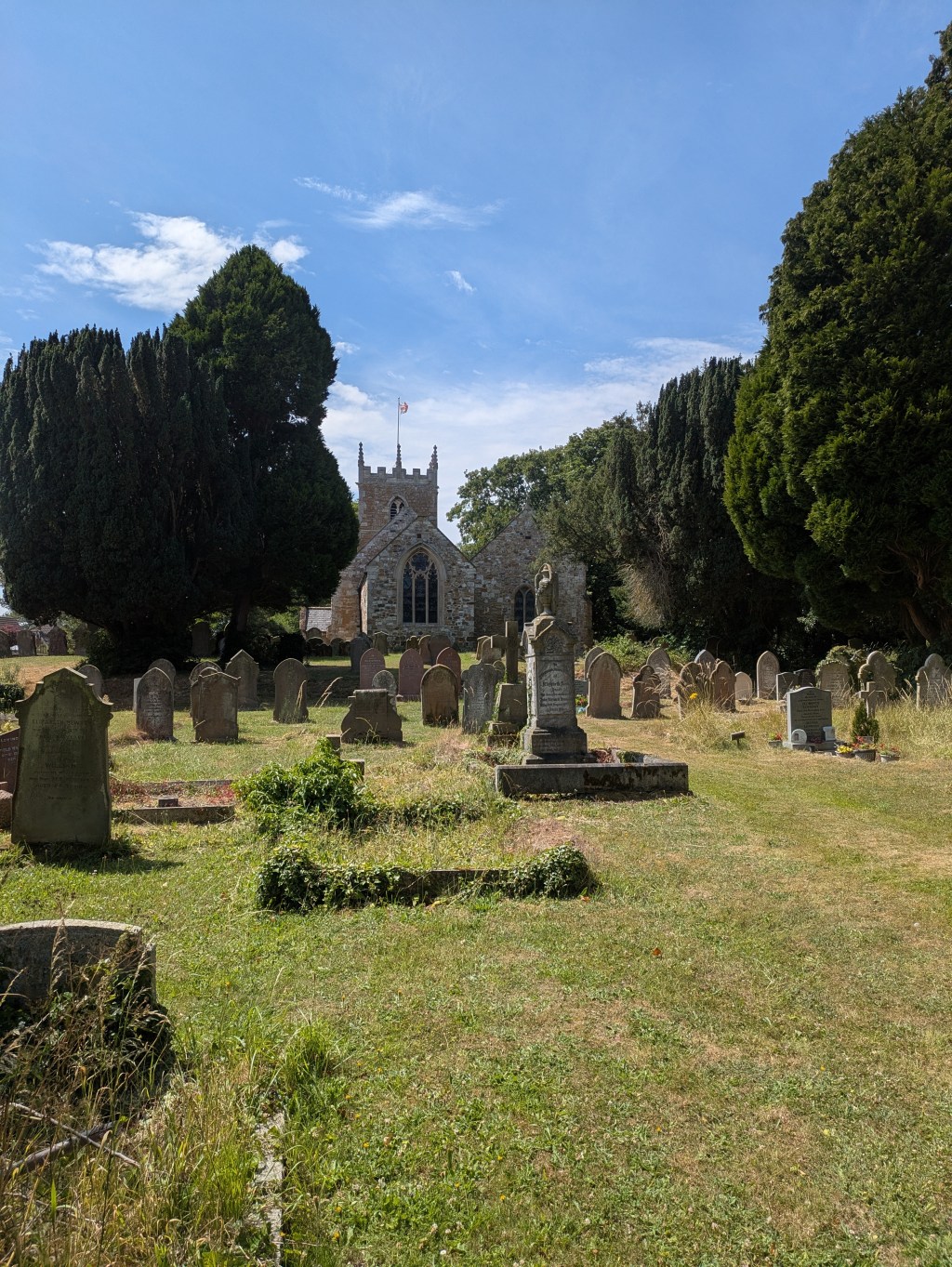
In A Dictionary of English Folklore, Jacqueline Simpson and Steve Roud note ‘a type of legend found throughout England’ in which the location of an ‘inconveniently sited’ church is said to be the result of malevolent forces repeatedly moving the stones until the builders relent. This is one unusually intriguing example. Dorrington’s St James’ church stands half a mile north of the village on a gentle hillock. Earthworks suggest the village has simply migrated south, but two local folk tales converge on a different explanation.
One version tells of Tochti, a Saxon thane, who used stones from a pagan site on the hillock to build his church in the village. They were moved back uphill by demons who emerged from a mature oak tree, so Tochti relented and built his church there instead. In another version, a church was being built in the village, but whenever the workmen were absent their work would be destroyed. One day, a large stone from the wreckage was moved to the present site, and once work began there it went uninterrupted.

Susanna O’Neill, in Folklore of Lincolnshire (2013), records a different legend – not a folk tale, but worth mentioning: ‘On a clear, moonlit night you can peek through the keyhole to watch the Devil playing with glass marbles across the church floor’.

The Devil was once also said occasionally to be seen hopping round the church in the form of a white rabbit or a hare. Malevolent beings – the Devil, witches, etc – were often assumed to take on the form of a hare, or in some cases that of a more traditionally unappealing creature. For example, Mary Borrows, in ‘Witches of Lincolnshire’, Lincolnshire Life (April 1986) tells of a witch from Dorrington who disguised herself as a rat; one day she was kicked by a villager, and the next morning she was discovered (back in human form) beaten and bruised. Borrows is drawing on anecdotes collected in the area by the folklorist Ethel H. Rudkin in the 1920s and 1930s, some of which can be found in her book Folklore in Lincolnshire (1936), though there are more examples in notebooks in her archive at North Lincolnshire Museum, Scunthorpe.
Daniel Codd, in Mysterious Lincolnshire (2007), documents a supposed witch from nearby Rowston who took on the form of a hare, was then shot by a farmer, and subsequently died (in human form) from a gunshot wound. (In the version of this tale provided by Borrows, she has first returned to her cottage somehow through the keyhole.) Lucy Wood, in The Little Book of Lincolnshire (2016), adds another comparable anecdote from nearby South Kyme (where you can see the South Kyme Tower, all that remains of a castle), in which an allegedly eavesdropping rat is welted with a hay fork, only for an old lady in the village later to be discovered with corresponding wounds. Gutch and Peacock (1908 – see ‘select bibliography’ on this website) collect many similar anecdotes from across the county. Some will provide supernatural explanations for natural phenomena, while others will either have been fabricated in their entirety, or used as excuses for abusing or murdering (and then vilifying) women.
The Heart of Lincs website delves deeper into the history of Dorrington.
Words by RORY WATERMAN
 Lincolnshire Folk Tales Project
Leave a comment