

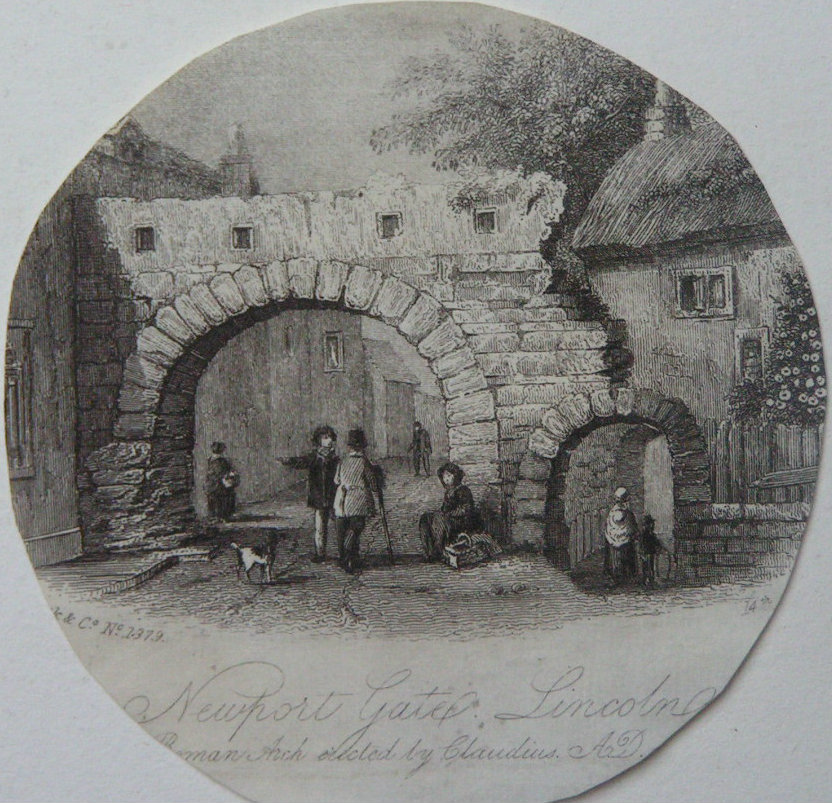
Lincoln – Lindum Colonia – was one of Roman Britain’s greatest towns, and it still contains several Roman ruins among (and in some cases beneath) its medieval, Georgian and Victorian splendours. According to this tale, a Centurion was marching his men along the Roman Ermine Street, towards what we call Newport Arch, the north gate of the city (incidentally the only Roman arch in Britain that is open to motorised traffic), when his horse suddenly refused to proceed. He examined the animal but could find nothing wrong with it. In confusion, he thoughtlessly picked a blade of grass, knotted it, and tossed it aside – at which point it transformed into a witch with her arms and legs tied around herself and her nose somehow stuck up her bottom.
‘Night then, kids!’ This feels like the beginning to a folk tale, not the full thing, but we can find no other sources, so it will have to do. Contributed by Maureen Sutton and Ken Pearson to their feature ‘Yellowbelly Folklore’, Lincolnshire Life (October 1998). Sutton claimed to have heard the tale from ‘the late Mrs K. Smaller […] who grew up in Hackthorn’, a village a mile east of Ermine Street and seven miles north of Newport Arch, so we have decided to mark this tale’s location close to the village on the former Roman road (now the A15). In British folklore, witches often shape-shift, usually into hares or much-maligned creatures such as toads, but occasionally into objects.
On 31 August 2024, at The Lawn, Lincoln, as part of the Lincolnshire Folk Tales Project and Heritage Lincolnshire event ‘Lincolnshire Lore’, Kathy Hipperston of Time Will Tell Theatre told an inventive first-person version of this story as a precursor to the tale ‘Byard’s Leap’. This may have been the first ever public performance of the tale. It went down very well, not least with the children, for obvious reasons!

Words by RORY WATERMAN
 Lincolnshire Folk Tales Project
Leave a comment