

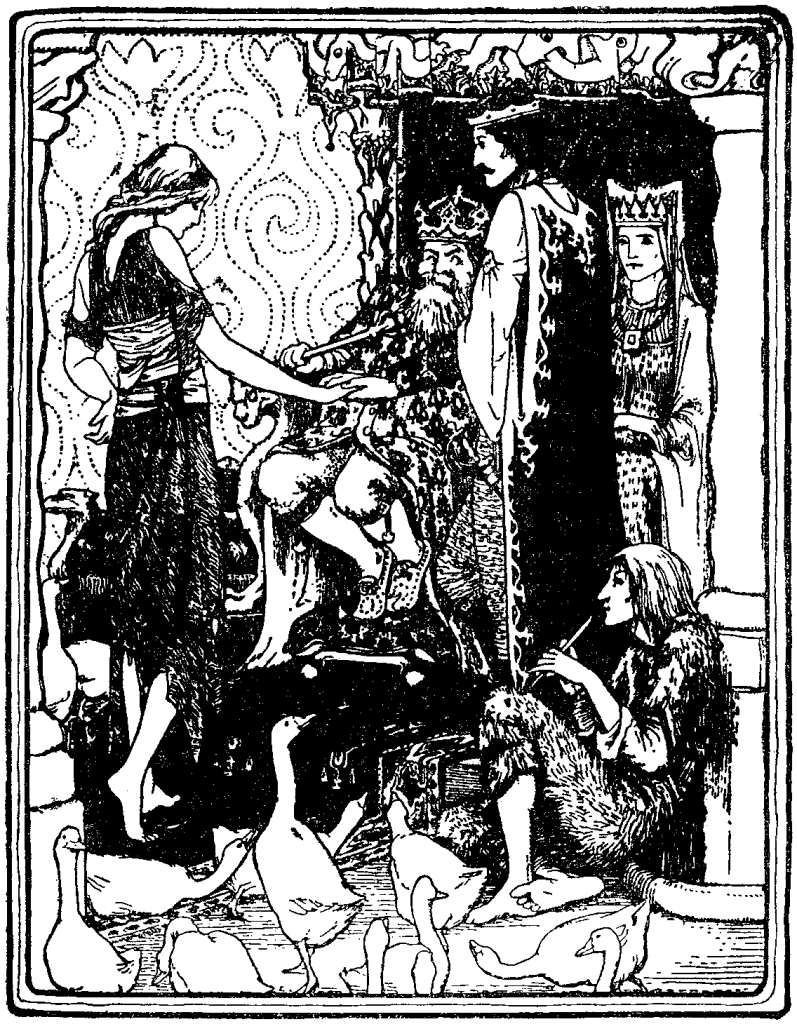
A rich, old lord, who lived in a palace by the sea, had no living wife or children, but he did have a granddaughter. However, as his favourite daughter had died during childbirth, he swore never to look after his granddaughter, and not even to look at her. The girl therefore grew up impoverished, and was known as Tattercoats because of her dishevelled appearance. She had only a gooseherd for a companion, who would play merrily on a pipe.
One day, the lord was invited to a royal ball in the town, and Tattercoats and the gooseherd decided to go and watch. As they made their way, they encountered a splendidly-dressed young man who was heading to the ball, and as they got to know one another the man asked Tattercoats to marry him. She told him to find his bride at the ball, but he persuaded her to meet him at the ball at midnight, dressed as she was – along with the gooseherd and his geese. She did so, as the clock struck midnight, to great amusement in the hall. They danced, and he took her up to the king – his father – and declared that this was the woman he wished to marry. The gooseherd played on his pipe, and as he did so her rags transformed magically into shining robes. The gooseherd was never seen again, and the lord returned to his palace by the sea, where he still sits by the window, weeping bitterly for his lost daughter.
The story was recorded by Marie Clothilde Balfour in Folklore (1891); she said she heard it from a small girl called Sally Brown. Joseph Jacobs adapted it for More English Fairy Tales (1894), and a version is included by Katharine M. Briggs in Folk Tales of Britain (1970). It is an example of what is known as a ‘Catskin’ tale, after the tale of that name collected by Joseph Jacobs in late Victorian England. Parallels with ‘Cinderella’ are obvious, as well as with other fairytales such as ‘Cap o’ Rushes’, first published in Ipswich in 1878. There are no obvious locations for the palace on the Lincolnshire coast, the city is not named, and it is likely no specific real locations were imagined for the story.
In October 2024, with Adverse Camber Productions and the storyteller Pyn Stockman, we spent a week at St Mary’s Catholic Primary School, Brigg, where year 4 chose to develop a play based on Tattercoats, blending it with Black Dog legends.

Words by RORY WATERMAN

 Lincolnshire Folk Tales Project
Leave a comment