

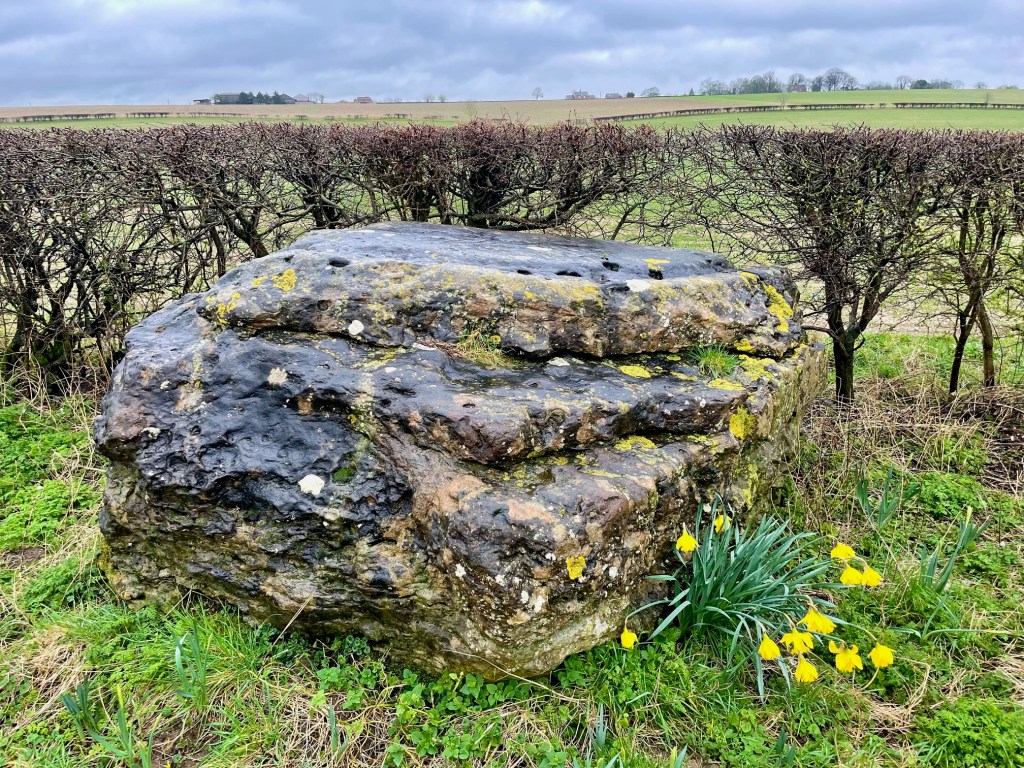
A boulder near Winceby, on the site of the Battle of Winceby (1643) – in which Oliver Cromwell (then a colonel) was almost killed but eventually the Parliamentarians proved triumphant – was said to mark the location of buried treasure, but whoever tried to move the rock would be destined to fail. Once, the story goes, farmers attempted the feat with horse and chains, and inadvertently summoned ‘God or the Devil’, at which point the latter appeared, leaving his claw mark on the top of the rock, frightening away the men, and stamping the stone back in among the clods. This folk tale is explored by Susanna O’Neill in Folklore of Lincolnshire. (2012), and in many other books. The boulder was finally moved from the neighbouring field in 1970, and is conveniently next to a small layby.
The Lincolnshire folklorist Ethel Rudkin, in ‘Lincolnshire Folk Lore’ (Folklore, 1934), collects anecdotes concerning futile attempts to move it, its burial in the field, and its later uncovering. James Alpass Penny also discusses this in Folklore Round Horncastle (Morton & Sons, 1915), at which time the boulder was submerged in a field. Locals take him to the spot, and tell him that this ‘was where the Duke of Wellington won the Battle of Waterloo’.

It is easy to see why legends involving the Devil would arise in this place, and Slash Lane and Slash Hollow are named appropriately. Slash Hollow forms a natural dip on the former battlefield, and it is said that retreating Royalists were trapped by a parish boundary hedge here, and by a gate that opened towards them, with inevitable consequences. The stone is beside an information board about the battle (which unfortunately does not mention the boulder and its legend).
A poem by the local historian Henry Winn, published in the Lincolnshire Chronicle in 1885, tells a slightly different version of the story, and refers to the rock as the Druid’s Stone. In this rendition, one Dan Potter, a beleaguered Winceby farmer, is encouraged by a ‘mystic voice’ to move the stone and uncover treasure, which he attempts to do with a team of men and horses. ‘Come God, come Devil, but we have it now’, he cries, as it finally wobbles from its berth,
When, dreadful to behold, and to relate,
A horrid shag foal trotted through the gate,
And, leaping on the stone, gave such a yell
As scarcely could be fancied out of hell.
The horses broke away, and horse and hind
Dispersed like driven chaff before the wind.
The foot-prints of the foal may still be seen
Upon the stone and keep the legend green.
The shagfoal, a shaggy-coated and often glowing-eyed Lincolnshire-specific counterpart to the gytrash, might be regarded as a beast after the Devil’s own heart, of course. Why did this version of the legend lose out to the simple Devil story? Probably because the most prominent indentation on the top of the Slash Hollow Bounder more closely resembles mark of a cloven foot than of a horse’s hoof. (Thanks to local historian Paul Hickman for drawing our attention to the poem.)
Versions of the story continue to be told. Jan and Paul Ramsey’s 2021 entry to the Write a Lincolnshire Song competition is here, at 25.20:
Another legend associated with the Battle of Winceby concerns Sir Ingram Hopton, the Royalist officer who decided to take Cromwell prisoner rather than kill him, and who was then killed himself, allowing Cromwell to return to the fray. Gutch and Peacock, in Examples of Printed Folk-Lore Concerning Lincolnshire (1908), cite the legend (provided in anecdote told to the travel writer James John Hussey in Horncastle a decade earlier) that Hopton died by having his head cut off, and that his horse then rushed back to the knight’s home in Horncastle, bearing his headless body.
Words by RORY WATERMAN
 Lincolnshire Folk Tales Project
Leave a comment