


The tale of ‘Little Hugh’ is perhaps the most prominent of several antisemitic stories involving child murder that proliferated in England in the twelfth and thirteenth centuries, and relates to one of many pogroms that culminated in the expulsion of Jews from England in 1290. Hugh’s death in 1255 led to the Crown prosecuting alleged Jewish ritual child murder, and a large number of executions of Jewish people.
Hugh, aged about nine at the time of his death, was allegedly mutilated and murdered in Lincoln by a Jewish man called Copin, who confessed (after being tortured) to having committed the murder and to throwing the boy’s body into a cesspit or well on his property. The child had allegedly been playing near the Jewish quarter, around Steep Hill, when he went missing. Copin was eventually hanged, alongside several other prominent Jews, just outside Lincoln, at a gallows which stood on the corner of Canwick Hill and Heighington Lane. Ninety other Jews were arrested at random and sent to the Tower of London, on the orders of King Henry III. The boy’s body was entombed in Lincoln Cathedral, his tomb referred to as the shrine of ‘Little Saint Hugh’ (though he had not been canonised), to differentiate him from the former Bishop of Lincoln, Saint Hugh. This proved a popular (and hence profitable) site of pilgrimage.
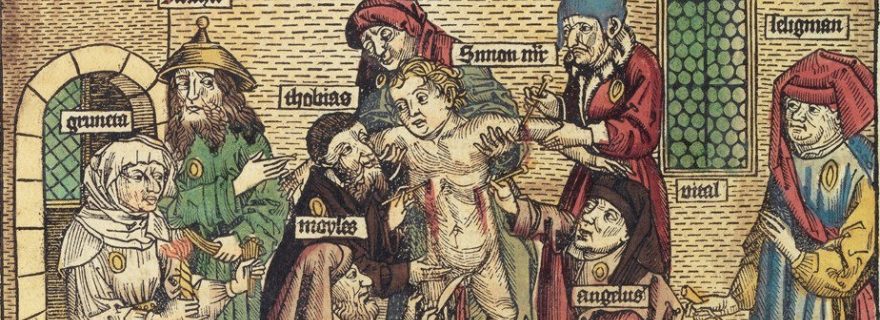
As Adrian Gray writes in Tales of Old Lincolnshire (1990), Little Hugh’s ‘story grew in the telling, of course, and […] was used to encourage further acts of racial prejudice against the Jews’. Daniel Codd, in Mysterious Lincolnshire (2007), notes that ‘the spiritual miracles and supernatural occurrences that were reported concerning the boy’s death may have been merely more propaganda designed to highlight the boy’s innocence and fuel the blame culture.’
Indeed. Stories soon grew up that Little Hugh had been discovered in Copin’s well because his dead body was heard singing the Magnificat, that his body showed signs of stigmata, and that upon his discovery all the church bells in the city started ringing and all books started reading themselves aloud. A blind woman claimed to have been healed by touching Little Hugh’s body. Folk tales and ballads soon arose, inspired by the chronicler Matthew Paris’s wildly fanciful contemporaneous account, in which Jews were said to have been summoned from across England to take part in the child’s sacrifice. The story undoubtedly influenced Chaucer’s ‘Prioress’s Tale’ in The Canterbury Tales, in which the zealous Prioress refers to ‘Yonge Hugh of Lincoln, slayn also’. In the early twentieth century, a well near the Jews’ Court at the bottom of Steep Hill was advertised as the one into which Little Hugh’s body had been thrown, but was discovered to have been built relatively recently.
The reporting of miracles was, of course, very common in late medieval England, and most such tales have died from public consciousness. Little Hugh’s has not, at least in Lincoln, partly because it serves as such a potent reminder of the evils of racial and ethnic prejudice.
All but the base of the shrine to Little Hugh in Lincoln Cathedral was destroyed after the Reformation, and in 1955 the Cathedral erected a plaque above it, which notes the following:
‘Trumped up stories of “ritual murders” of Christian boys by Jewish communities were common throughout Europe during the Middle Ages and even much later. These fictions cost many innocent Jews their lives. Lincoln had its own legend and the alleged victim was buried in the Cathedral in the year 1255. Such stories do not redound to the credit of Christendom.’
This is, we feel, sensitive, forthright, and fitting.
Words by RORY WATERMAN



 Lincolnshire Folk Tales Project
Leave a comment