

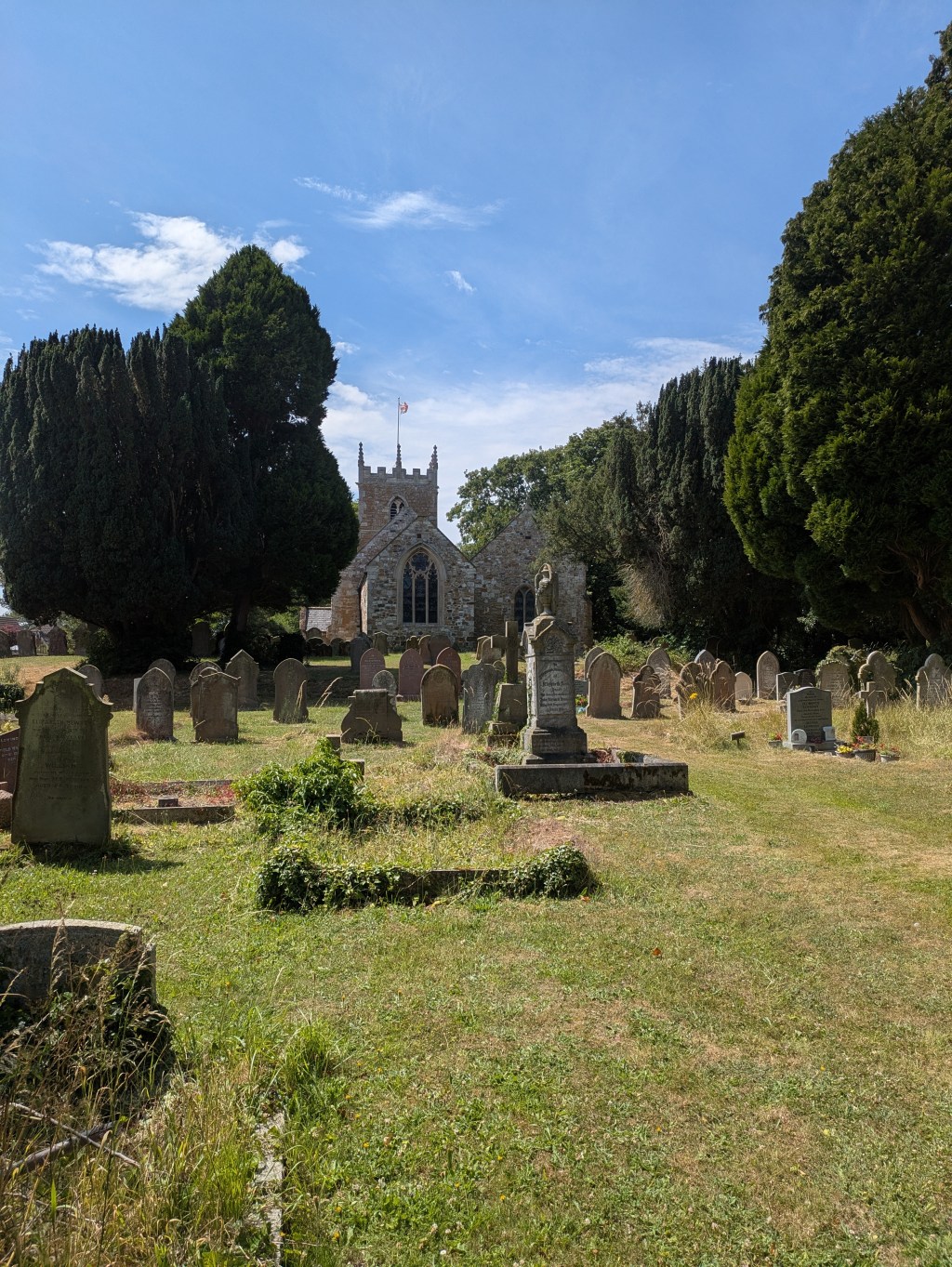
A dim-witted giant and his clever, goodly dwarf friend go wandering, the dwarf in his friend’s pocket, and come across a field of sheep. Being hungry, they decide to eat some of them: the giant kills two rams, and the dwarf calls out to all his local dwarf friends and together they kill and feast on a lamb. Unfortunately, the local sheep farmer is an angry wizard, who can detect lies. He asks what has happened, and the dwarf, ventriloquising the giant from his pocket, manages to convince the wizard of his innocence. Tuckered out by the effort he has put into this, the giant then kills and eats most of the flock, and the wizard catches and enslaves him. But the wizard puts the giant to good work, moving some hills from Yorkshire to protect north-west Lincolnshire from the flooding Trent. For that reason, we have dropped this pin on a public footpath on top of one of these ‘hills’, at a whopping 28 metres above sea level.
This tale was – or so she claimed – collected by Ruth Tongue, who called it ‘In My Pocket’, and first published in her book Forgotten Folk Tales of the English Counties (1970; republished by Routledge, 2016). It is impossible to authenticate this tale, and it is possible Tongue simply made it up, along with others in the same volume. (Tongue claims, fancifully, that ‘Perhaps Professor [J. R. R.] Tolkien came across a variant’ when he wrote a riddling contest between Bilbo Baggins and Gollum in The Hobbit.) Nonetheless, Susanna O’Neill includes a version called ‘The Giant and the Dwarf’ in Folklore of Lincolnshire (2013), as does Adrian Gray in Tales of Old Lincolnshire (1990).
Words by RORY WATERMAN
 Lincolnshire Folk Tales Project
Leave a comment