

The name Grimsby comes from the Old Norse male name Grímr, and the suffix ‘by’, which denotes a settlement. That is all we know for fact, but there hangs a tale. That tale has a written literary source (see below), and a possible origin (and certain subsequent legacy) in folklore. The tale is as follows:
Havelok, rightful king of the Danes, is brought up by a lowly, well-intentioned fisherman called Grim. Grim had been commissioned by Godard, usurper of the Danish throne, to kill the boy, but had instead sailed with him across the North Sea to safety and thus established Grimsby. According to legend, the child grows to be supremely big and strong, as well as gentle and chivalrous. Following many tribulations, Havelok eventually exacts revenge and asserts his rightful place, with the help of his wife Goldborough, who is herself the legitimate heir to the English throne. The couple subsequently rules both Denmark and England as king and queen for sixty years, and they have fifteen children.
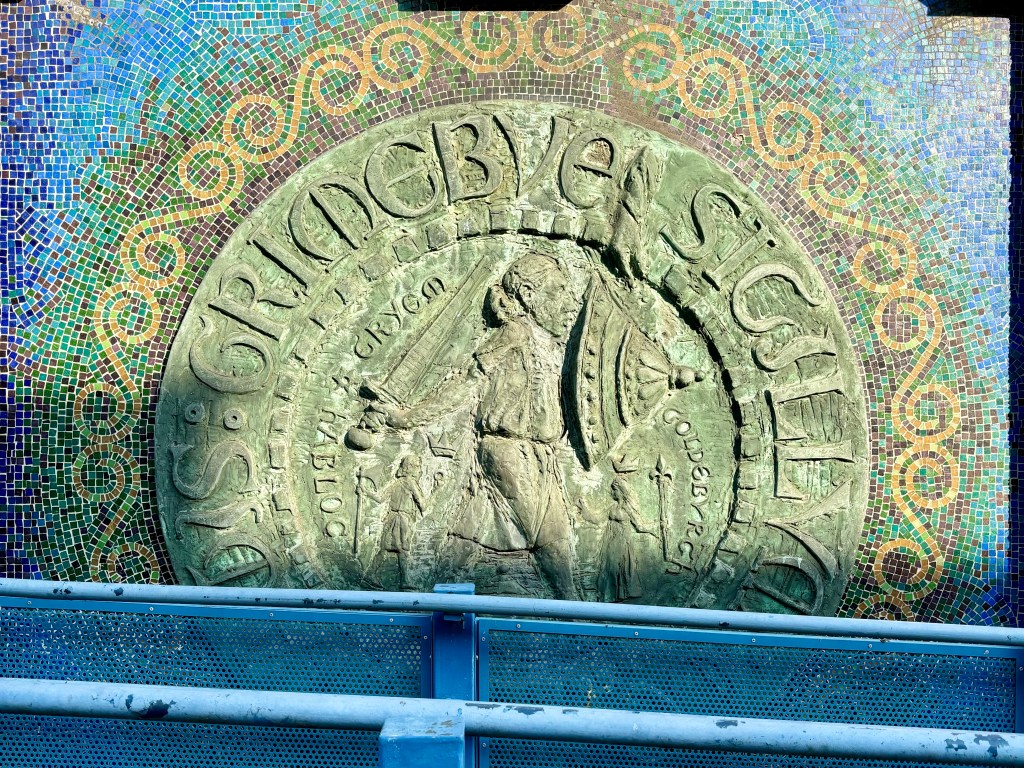
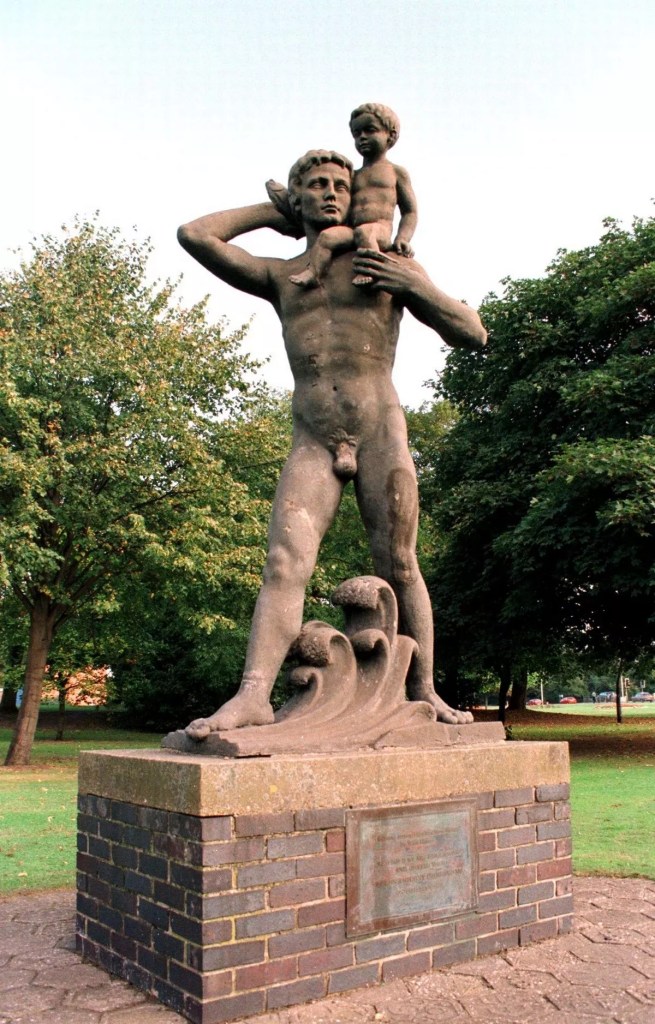
Grimsby’s old seal depicts the legend, and a mosaic rendition of it is on the wall of Grimsby Central Library, though unfortunately part of it is obscured by a metal railing. The seal possibly dates to the thirteenth century, and depicts Grim wielding a fat sword at its centre, with Havelok and Goldborough either side of him, crowns floating above their heads to reflect their regal natures.Havelok is said to be a champion in rock-throwing competitions, and according to legend one of the stones he threw, called the Havelok Stone, used to be visible outside Welholme Galleries in Grimsby, but has been removed and is in museum storage locally. (Thanks to Paul Hickman for this information.) A statue of Havelok and Grim by Douglas Wain-Hobson was installed outside Grimsby College (now Grimsby Institute) in 1973 and removed in 2006. As of June 2024, it has been restored and is back on display, at Grimsby Fishing Heritage Centre. It will soon be installed permanently at Freeman Street Market.
In 2021, Bird in the Hand Theatre produced the following (two-part) stop-motion animation to tell the story, commissioned as part of Grimsby’s Festival of the Sea:
Havelok the Dane: A Legend of Old Grimsby and Lincoln (1900) by the historical fiction author Charles Watts Whistler is available in audio form on YouTube:
Modern retellings include Maureen James’s in Lincolnshire Folk Tales (2013), Polly Howat’s in Ghosts and Legends of Lincolnshire and the Fen Country (1992), and Adrian Gray’s in Tales of Old Lincolnshire (1990). Rahul Gupta’s rendition, in alliterative verse, is included in Lincolnshire Folk Tales Reimagined (Five Leaves Publications, 2025), the anthology published by the Lincolnshire Folk Tales Project. The earliest extant rendition of the narrative is in Geoffrey Gaimar’s chronicle Estoire des Engleis (c.1135), the oldest surviving chronicle in French, written for the wife of a landowner in Lincolnshire. The thirteenth-century romance Havelok the Dane is available in the original Middle English with glosses here. (available here: https://gutenberg.org/ebooks/32049) It tells a version of the story in 3001 lines, and is its most famous source; a copy of the manuscript can be viewed in Grimsby Public Library. The origins of the story may be considerably older, and it is clearly set before the Norman conquest.
Words by RORY WATERMAN
 Lincolnshire Folk Tales Project
Leave a comment