


According to one version of this tale, associated with two boulders (probably previously one bigger boulder), a plough horse vanished in quicksand, and a drake (or in some versions a dragon) flew out in its place. The following day, a boulder shaped like a drake’s head (or a dragon’s in some versions) appeared on the spot. In a competing narrative, recounted in the Gentleman’s Magazine in 1833 and quoted by Maureen James in Lincolnshire Folk Tales (2013), the devil, or a demon, lived under the stone in a treasure-filled cave. Locals tried to dig down to it, but could never reach the bottom of the stone, and after rains came it ended up as an island in a small pond. Nobody could move the rock, no matter what they tried, and on one occasion the guardian spirit of the stone flew away in the guise of a drake when someone tried to move it with oxen. Eventually, however, it certainly was moved, by traction engine in the 1920s, and according to tradition it broke in two during the process, and both chunks were left outside the church, where you can still see them (though unfortunately there is no sign to tell you what they are).
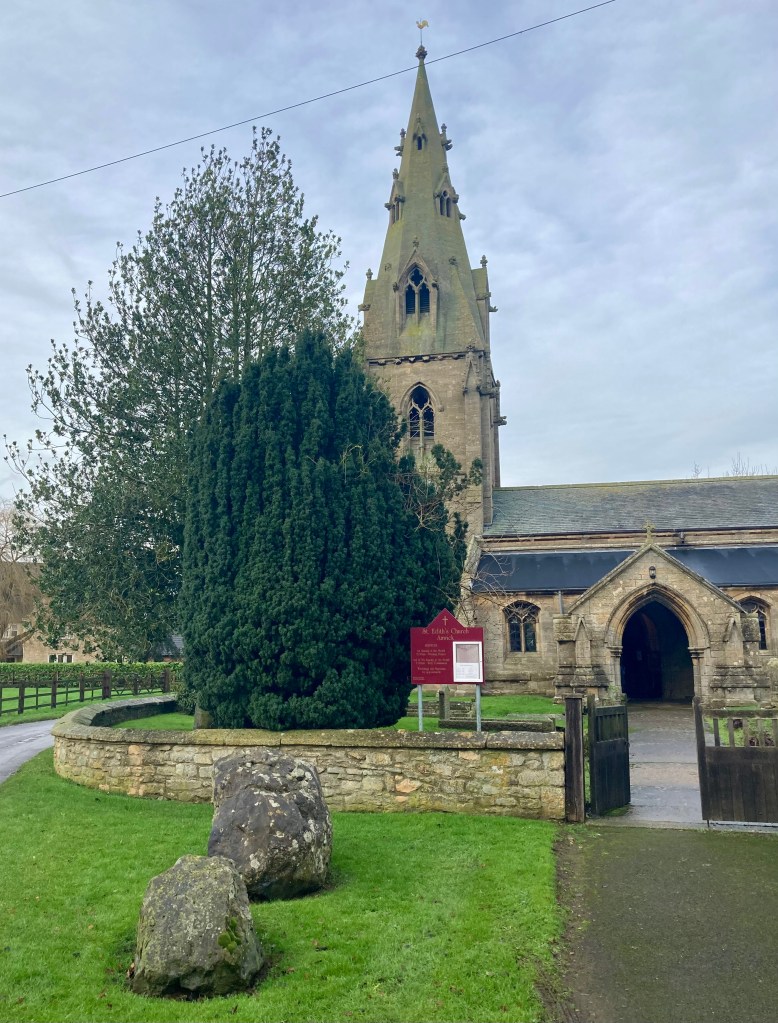
Along with several other antiquarians and historians, Adrian Gray in Tales of Old Lincolnshire (1990), suggests ‘drake’ is a corruption of ‘dragon’. This is feasible, not least because ‘draig’ is Welsh for ‘dragon’, and it is correspondingly feasible that the drake-related aspects of the legend developed as a result. The dragon may itself be an analogue for a demon, which would bring all competing versions of the tale back together. Reverend George Oliver, writing in 1837, notes that ‘There was a running tradition’ – note the past tense, implying a story that was both old and also at that time already largely out of currency – that the stone had been placed in a field about half a mile to the north-west, ‘to indicate the presence of treasure which had been buried on the spot’, where it was ‘under the especial protection of the Devil’. It is not uncommon in folklore for demons to guard pits or caves full of treasure. However, David Clark, in It Happened in Lincolnshire (2016), gives a more mundane explanation: the rock, probably a glacial erratic, was a hazard to ploughing, so a farmer with a cunning plan dug a trench around it in an attempt to sink it ‘to a safe level’. The trench filled with water, and a legend was born. Perhaps.
Many legends from Lincolnshire, and elsewhere, concern stones that seem to have a will and force of their own – or of whoever or whatever put them there – and express that will by being difficult or easy to move. For example, the tallest stone at the Neolithic Rollright Stones stone circle in Oxfordshire was said to have taken twenty-four horses to drag down the hill, where it was used as a bridge, and to have killed two men in the process, but only to have taken two horses to return to its rightful place. Other allegedly hard- and easy-to-move stones include those found at Fonaby.
Words by RORY WATERMAN

 Lincolnshire Folk Tales Project
Leave a comment