


‘Crazy Kate’, the woman on whom this story is based, was probably, like most ‘witches’, simply a slightly reclusive woman to whom the locals took a disliking, encouraged by their disposition towards superstition. She apparently owned three cats, her ‘familiars’, and it was said that at night she would head to Manwar Ings (often in more recent sources called Manwar Rings) – a round earthwork, now thought to be a tenth-century Danish encampment that two centuries later became a motte and bailey castle – to take instruction from the Devil.
Some of the locals decided to keep an eye on her, and hid in her garden for three nights, but saw no sign of her. They assumed she had discovered them, made herself invisible, and fled: there could be no other explanation. They broke in, saw her cats and her broom, and were then accosted by Kate, who promised to curse the lot of them. They rushed to the pub, and decided on a plan of action: they sent a messenger to her house to tell her she had fourteen days to leave the village for good. This achieved nothing but scorn, ridicule, and immediate ill fortune for the villagers, so they returned and confronted her again.
However, when they turned up, she was not there – the Devil had obviously tipped her off – so they went to Manwar Ings. She was standing on the top of the bank, but just as they strode menacingly towards her, a stranger on a black horse thundered up, lifted her, and galloped off into the night.

The mob then returned to her cottage, and burned it to the ground, with the cats inside, and Crazy Kate was never seen or heard from again.
Polly Howat gives a detailed account of the tale in Ghosts and Legends of Lincolnshire and the Fen Country (1992).
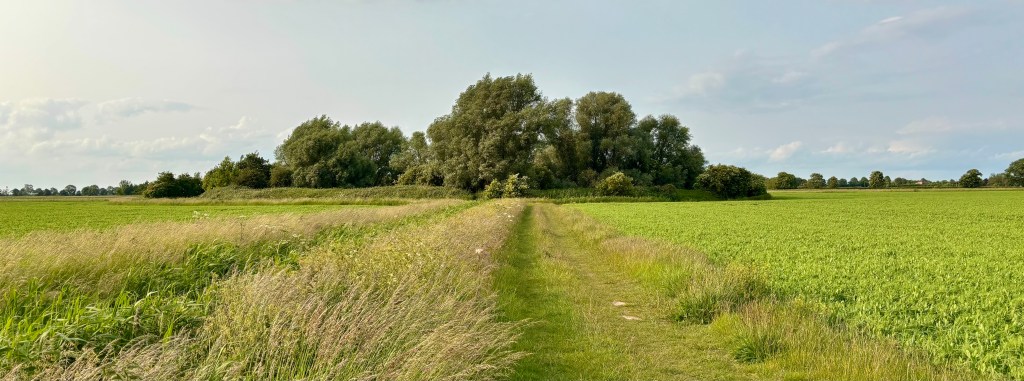
Manwar Ings is traversed by a public footpath. It is an evocative site, if you visit in the summer months; at other times, the inner of its two moats is likely to be flooded. There is scant remaining stonework, but the earthworks are quite impressive, and there are a few brick and concrete relics from the Second World War, built by the Home Guard. King John spent a short time at Swineshead Abbey (half a mile east of Manwar rings, and long since demolished) shortly before he died, and after apparently losing much of his baggage and possibly the crown jewels in the Fens. According to legend, he did not die of dysentery, but was poisoned while at Swineshead.
Words by RORY WATERMAN


 Lincolnshire Folk Tales Project
Leave a comment